
Choosing The Perfect Chess Table and Chairs For You
Growing up in a family that loved chess, you can be sure we had a designated corner just for our chess table and chairs. Believe me, it held a higher status than almost anything else in the house.
And if you ever dared put a glass of water, a cup of tea, or anything remotely unrelated to chess on it? You were banned from using it for at least a month. We, kids, loved that table too much to ever mess with it, and looking back, the memories we made around it are unforgettable.
Which makes me wonder… does someone out there right now wish they had their own chess table?
If you're one of them, I encourage you to stick around. I’ll not only share some of the best tables out there but also walk you through everything you need to know before buying one.

A Short History of Chess Tables (and the Chairs Around Them)
You know I found something that might surprise you… The chess table has been around for a lot longer than most people realize.
Oh, and believe me, its story is anything but boring.
It starts, as most great things do, with a game.
Around 1,500 years ago, in ancient India, people were playing something called Chaturanga. But back then, it wasn't chess the way we know it today.
It was closer to a simulation of military strategy with four divisions, four pieces, and one objective. But it planted the seed, and the game traveled west.
Persia picked it up, adapted it, and called it Shatranj.

The Camaratta Collection - The Botvinnik Flohr Series Chess Pieces - 4.0" King

Leap Digital Classic Chess Clock

US Chess Premium Chess Box
By the time it reached medieval Europe, chess had become something royalty and scholars couldn't get enough of. That's when the furniture started to matter.
Dedicated chess tables had become fashionable across Europe in the 18th century. But, here’s the thing… nobody was mass-producing them in a factory.
Wealthy families commissioned artisans to build them by hand, using the finest materials available: rosewood, walnut, teak, marble, ivory, and brass.
Some tables had reversible tops; chess boards on one side, felt or leather on the other for cards. Some had hidden drawers tucked into the frame, designed to store pieces (and probably a few secrets).
A good chess table and chairs set in your drawing room said something about you. It said you had taste, education, and the leisure time to use both.
Queen Victoria herself was known to play regularly, especially during her widowhood.
As craftsmanship became more accessible and the game spread beyond aristocratic drawing rooms, chess tables slowly found their way into homes that didn't have staff or sprawling estates. The care and skill that went into making them became available to more people.
Today, a well-made chess table and chairs can sit just as beautifully in a cozy apartment as in a grand library.
Why a Chess Table and Chairs Belong in Your Home
Yeah, I know… I'm a little biased here.
Hey, growing up around a chess table will do that to you.
But even setting aside the nostalgia, there are genuinely good reasons to bring one home, and none of them are as obvious as "because you like chess."
It becomes the focal point of the room without trying
You place it in a room and something shifts. Guests notice it before they notice anything else. I remember how some of my relatives used to run a hand along the edge, asking where we got it.
It doesn't matter whether it's a sleek modern design or a richly carved vintage piece. A good chess table and chair setup draws people in the way a fireplace does. It gives the room a center, a reason to gather, a story to tell.
It earns its place even on days you don't play
One of the most underrated things about a chess table is how useful it is when no one is actually playing chess. Many designs feature built-in drawers or compartments to keep your chess pieces organized and out of sight.
When the board is clear, the table functions beautifully as a side table, a display surface, or simply a beautiful object in the room.

The W.T. Pinney Series Chess Pieces - The Camaratta Collection - 4.75" King

Tap N Set Pro Digital Chess Clock - with DOUBLE DISPLAYS

Signature Fitted Coffer Chess Box - Walnut Burl
Some convertible designs go even further, offering a second surface for cards, backgammon, or casual dining.
So if you have ever worried about dedicating floor space to something you use occasionally, this is the kind of furniture that takes that worry off the table entirely (pun intended, and fully committed to).
It's the kind of thing you pass down
A quality chess table and chairs set is not furniture you replace when you redecorate. It's furniture that outlasts trends, the room it started in, and sometimes the person who first brought it home.
Decades from now, someone in your family might sit at that same table, look at a worn corner or a faint ring from a forgotten cup of tea, and feel connected to something.
How to Choose the Right Chess Table and Chairs
So you know the history, you know why you want one, and you may have a rough sense of which type appeals to you.
Now comes the part where you actually make the decision, and that means thinking through a few practical things before you spend your money.
Start with size
Before you fall in love with a specific design, measure the room it's going into.
You know, I can hear you rolling your eyes right now.
Trust me, I know this sounds obvious, but it's surprisingly easy to misjudge. Think about how much space you need around the table, not just the table's footprint.
You and whoever you're playing with both need room to pull chairs out, sit comfortably, and move around without bumping into other furniture.
A chess table and chair setup should feel settled in a room, not squeezed into it.

The Library Imperial Collector Series Luxury Chess Pieces - 3.0" King

Luxe Premium Chess Box - Amboyna Burl

The House of Staunton DELUXE Tournament Bag
Think carefully about material
The material your table is made from affects how it looks, lasts, and how much maintenance it quietly demands from you over the years.
You have your traditional hardwoods like walnut and rosewood. They're durable, age beautifully, and develop a kind of character over time that cheaper materials simply… don't.
If you want something that leans more contemporary, metal frames with clean lines work well in modern interiors.
Marble surfaces add genuine luxury but come with weight and care requirements worth knowing about before you commit.
Match the style to your space, not just your taste
It's tempting to choose a chess table based purely on what you find beautiful, and your instinct isn't wrong. But the table also has to live in a room alongside everything else you already own.
A heavily carved Victorian-style table can look stunning in a home with warm, traditional interiors and feel completely out of place in a minimalist apartment with clean lines and pale walls.
Take a look at the furniture you already love in your home and let that guide you. A great chess table and chairs combination should look like it belongs exactly where it is, not like it wandered in from a different decade.
Set a budget you're honest about
Chess tables span a wide range. So, before you start browsing, it helps to know where your ceiling is so you're not constantly comparing what you can afford to what you can't. What's worth remembering is that a well-made chess table is not really furniture in the disposable sense.

The Burnt Dubrovnik Series Chess Pieces - 3.75" King

DGT 2500 Digital Chess Clock

Premium Chess Box - Brazilian Rosewood
It's closer to an heirloom purchase, something built to last decades and potentially longer.
Spending more upfront on quality craftsmanship often means spending nothing on a replacement down the line, and that changes the calculation considerably.
Three Chess Tables Worth Knowing About
There are a lot of chess tables out there, and most of them are perfectly fine.
But some of them are genuinely special.
The kind you find yourself thinking about after you've closed the browser tab. The two tables below have their own character, and together they cover a wide range of what a great chess table-and-chairs experience can look and feel like.
The Camaratta Signature Master Chess Table
This table was designed by Frank A. Camaratta Jr., and the moment you see it you understand that someone with real opinions about chess made it.
It's built from curly maple and rosewood (two woods that have no business looking as good together as they do).

The playing surface measures 19 inches square with 2.375-inch squares. For context, that's a size serious players actually want to sit at. There's room for a chess clock, a score pad, and whatever you're drinking, without anything feeling cramped.
The built-in drawer is deeper than you'd expect and stores a full set of pieces with space to spare.
If you've ever finished a game and spent the next five minutes hunting for a bishop that rolled under the sofa, you'll appreciate this more than most.
The Master Table is tournament-ready in its proportions. But refined enough that it looks completely at home in a living room. It's the kind of chess table and chairs pairing that works for both the serious player and the casual host.
The Camaratta Signature Championship Chess Table
Made from Macassar ebony and bird's-eye maple, it has a visual richness that's hard to describe without sounding like you're overselling it. But you really do just have to see the grain on Macassar ebony to understand why people choose it.
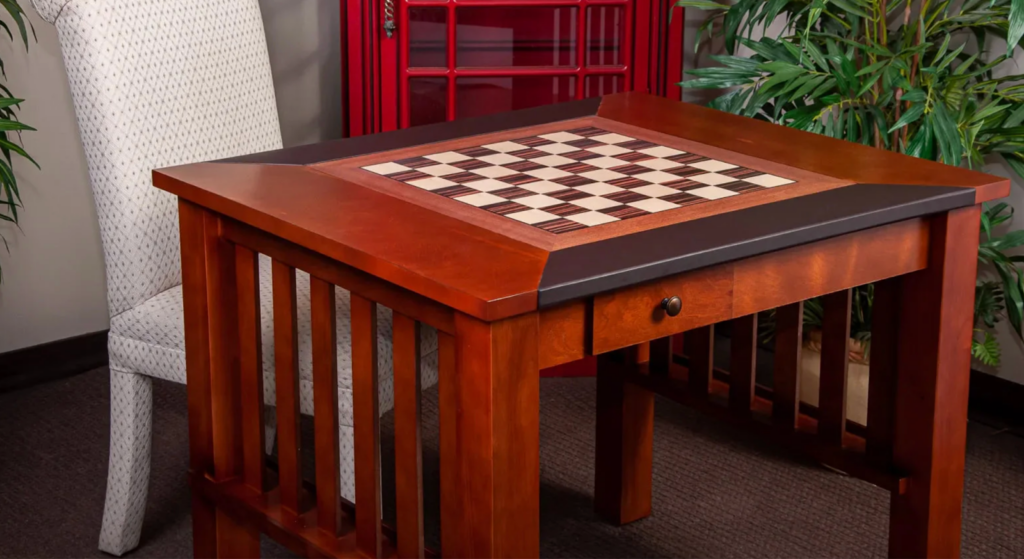
What sets this table apart, beyond the materials, is the attention to comfort. It comes with padded leather armrests. Which sounds like a small detail until you're an hour into a long game and you realize your elbows have been thanking you the entire time.
Storage drawers sit on both sides of the table. So both players have somewhere to keep captured pieces and personal items without reaching across. As a chess table-and-chair setup, this one is designed for players who want the full experience, not just the game.
A Table Worth Coming Back To
Whether you're drawn to the rich warmth of rosewood or something foldable and practical, there's a chess table out there that belongs in your home.
You just have to know what you're looking for, and now you do.
Take your time, trust your instincts, and choose something you'll want to pass on someday.