
Freestyle Chess: What’s All the Hype?
The 2025 Freestyle Chess Grand Slam Tour was a huge event culminating in a dramatic final in Cape Town, South Africa. Magnus Carlsen, Levon Aronian, and Fabiano Caruana took the top three spots in a hard-fought battle. But what is freestyle chess? And why is it the most popular chess variant today?
Let’s explore how this twist on the classic game became a significant part of the 2020s chess boom.

What is Freestyle Chess?
Freestyle chess is otherwise called Chess960 or Fischer Random Chess. It follows the same rules of chess with one key difference: the starting positions of the pieces on the back rank are randomized.
This essentially makes it impossible to prepare specific openings. It no longer matters if you have memorized every variation in the Sicilian Defense; you are going to have to figure everything out from scratch.
Bobby Fischer is credited with inventing or at least formalizing Fischer Random in the 90s. He believed that chess had become too reliant on opening theory. This chess variant is intended to put the focus back on pure calculation, Fischer’s specialty.

The Library Imperial Collector Series Luxury Chess Pieces - 3.0" King

Luxe Premium Chess Box - Amboyna Burl

The House of Staunton DELUXE Tournament Bag
There are 960 possible starting positions in this chess variant. This makes it almost impossible to prepare for specific opening variations. Instead, players must quickly figure out how to develop effectively based on the unique back-rank positions.
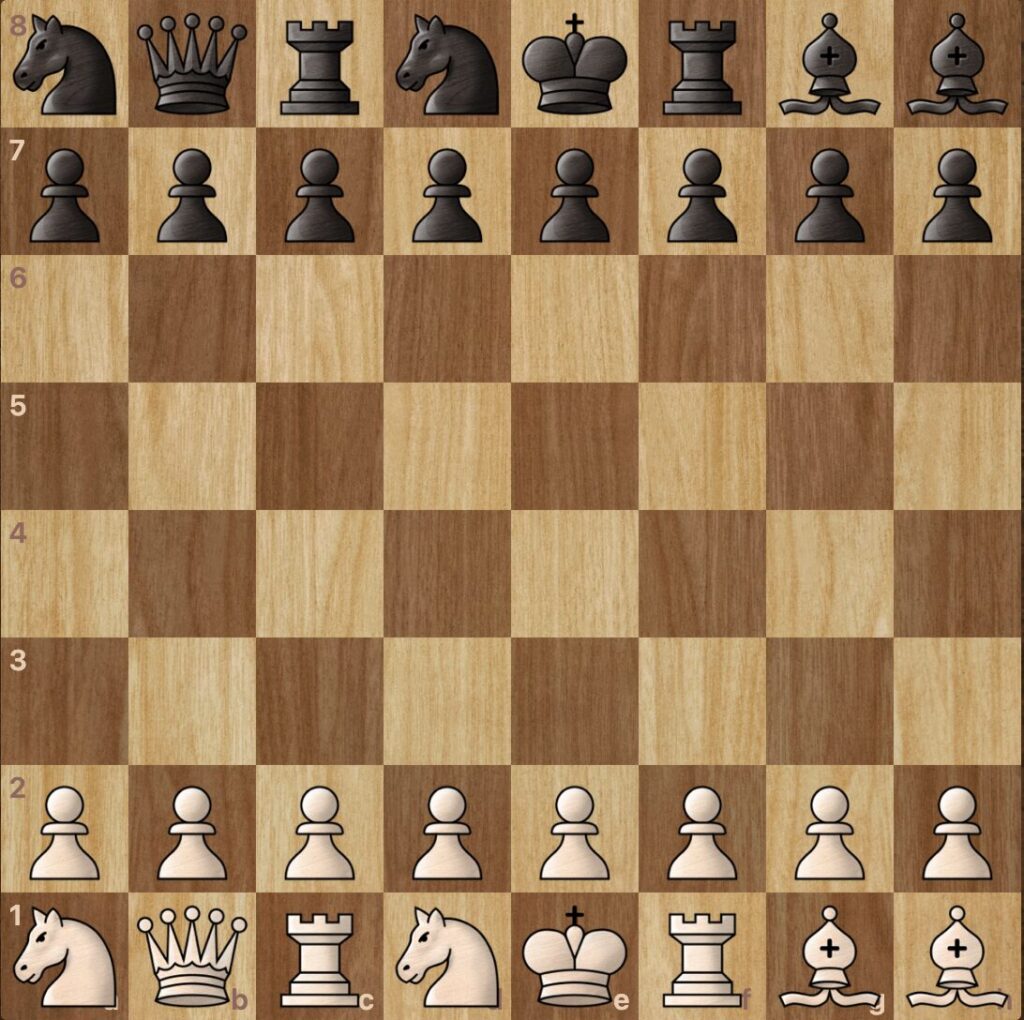
The Rules
The main idea is simple, but there are a few nuances in the rules of freestyle chess. Let’s take a look:
- The starting position is randomized, but is the same for each player.
- Each of a player’s bishops must be on a different colored square.
- The king must be between the rooks to allow for castling.
- Despite the random starting position of the king and rooks, they end up in the standard game position after castling.
Why is Freestyle Chess the Most Popular Variant?
Chess variants add interesting depth, possibilities, and excitement to the game. There is the chaotic element of variants like bughouse and 4-player chess, or the novelty of variants like duck or atomic chess.
Today, freestyle chess is immensely popular. Both online and over the board, there are many tournaments in the classical, rapid, and blitz chess formats. The success of freestyle chess is partly the simplicity of the rules. Anybody who knows the rules of chess can quickly grasp how to play freestyle. Despite this simplicity, the game is extremely challenging. Players have to calculate from the very beginning without relying on memorization or development principles.
This is also why it is played so much at the highest level. Grandmasters see Chess960 as a real test of their chess-playing abilities.
Why You Should Try Freestyle Chess
Beyond being a fun variation on a classic, freestyle chess is a great way to challenge yourself and understand how to calculate effectively in the opening. One trap intermediate players tend to fall into is memorizing a series of opening variations without thinking about why the moves make sense. Automatically playing openings makes it difficult to handle unexpected moves and spot potential weaknesses in an opponent’s position.

The *NEW* Austrian Coffeehouse Series Chess Pieces - 4.0" King

Premium Chess Box - Golden Heart

The Large Ultimate Chess Bag
Enter freestyle chess. Presented with a random order of back-rank pieces, you have to effectively invent your opening from scratch.
To create an effective opening, you have to ask yourself questions such as:
- How should I create space for my bishops?
- Which pieces do I need to move to allow for castling in either direction?
- How will pawn moves affect the safety of my king?
- How can I create a strong pawn structure?

Here is one of the 960 possible starting positions. A good starting move here might be 1. f4. This opens up a powerful diagonal for the bishop, puts a supported pawn in the center, and could lead to a semi-open file for the rook.
This kind of thinking is crucial in standard chess. Combined with a knowledge of opening theory, it can help you to dominate the first stage of the game.
Starting Strong: How to Be a Good Freestyle Player
Outside of the starting positions, the rules of freestyle chess are the same as standard chess. With this in mind, the way to dominate at freestyle is to hit the ground running with a strong opening. Here’s how:
Assess the Starting Position
The first thing to do in a game of freestyle chess is to carefully consider the starting position. Look at which pawns might be wise to move first, and simple ways for your knights and then bishops to develop.
To assess the starting position, note potential strengths and weaknesses. Ask questions like, Is the king in the center of the file or on the flank? Are there any central rooks? Can the bishops become useful without moving from their starting positions?
As you answer these questions, an opening plan should begin to take shape. If you start from a clear assessment of the starting position, you are halfway towards developing correctly.

The Camaratta Collection - The Botvinnik Flohr Series Chess Pieces - 4.0" King

Leap Digital Classic Chess Clock

US Chess Premium Chess Box
Figure Out Castling Quickly
If, when, and how you castle is extremely important in freestyle chess. It also takes more consideration.
One thing to consider is how many pieces are between the king and the rook on both sides. In some cases, if the king and rook are off to one side with a single piece between them, you can castle very quickly. In other cases, you might want to develop most of your pieces so that both forms of castling are open to you.
Castling often has the benefit of protecting your king and bringing your rook to a central file. It also helps freestyle chess beginners to reach more familiar positions. Be careful, though, because a safe castle in standard chess may not translate in certain freestyle arrangements.

In this position, all you have to do is move the bishop from f1, then you can short castle simply by jumping the rook over the king.
Remember the Principles, not the Opening
As you consider how to proceed, remember that your opening principles still apply. While the specific moves of a given opening will not apply, the underlying ideas often will.
In freestyle chess, you should still:
- Look for a way to control or contest the central squares of the board.
- Develop your knights and then your bishops.
- Protect your king, usually by castling.
- Bring your one or two rooks to the center (if they aren’t already there!)
- Avoid bringing your queen out too early unless you have a clear plan on how to use it.
- Create strong pawn structures and avoid weaknesses like doubled and isolated pawns.
These and many other opening ideas are still crucially important in the world of freestyle.
Be Creative
Part of the fun of freestyle chess is creating unexpected and interesting variations in the opening. Once you’ve assessed the position, you can see how you want to proceed. There might be an option to create a strong defensive structure, but in many Chess960 positions, you can be more aggressive, using the starting positions of long-range pieces as a weapon.
Freestyle chess abandons opening theory and leaves you with a massive opportunity to be original. There are so many ways to proceed that you can really explore unusual possibilities.
The *NEW* Austrian Coffeehouse Series Chess Pieces - 4.0" King

DGT 3000 Digital Chess Clock

The Camaratta Signature Championship Chess Table - Dark Brown
Game Example
Look at the opening moves from this game between grandmasters Vincent Keymer and Arjun Erigaisi.

Both quickly open up lines for the flank bishops, pointing at the pawn in front of the king. They continue with this hypermodern approach. Erigaisi, with Black, develops solidly, continuing to open lines for bishops and preparing to advance pawns further into the center. With White, Keymer plays more aggressively, taking up more space with pawns, while also opening up the bishops and queen.
The players' assessments likely noted that the bishop on a1 is already strong and points towards the king, even if it castled short. Similarly, the players chose to keep the pawns near the king in position initially, because it is already quite well-protected. Overall, applying considerations like this to your freestyle games can help you win more chess matches.
Next Step: Give it a Try!
Experiment with freestyle chess to become a better all-round player. After the initial weirdness of trying out the variant, it becomes an engaging and exciting version of the game. It also teaches you a lot about how to approach the opening in standard chess.
Online freestyle chess is available on Chess.com and other platforms. For over-the-board play, chess federations and local clubs often hold freestyle chess events and tournaments. Give it a try!
Frequently Asked Questions
Freestyle chess is a recent name for what was previously called Chess960 and Fischer Random. Freestyle chess involves randomizing the back-rank pieces and is part of various chess tournaments and events.
The difference between freestyle and standard chess is the starting position. In freestyle chess, the back-rank pieces are randomized. This means players have to calculate carefully from the first move without any opening memorization.
Bobby Fischer is credited with coining the name Fischer Random Chess, another name for the variant. He also popularized and formalized the variant in the 90s. However, versions of the game did exist beforehand.
The chess variant called variously Freestyle Chess, Chess960, or Fischer Random is not owned by anyone. However, Magnus Carlsen is an owner and co-founder of The Freestyle Chess Grand Tour, a series of tournament events, started in 2025.
There are many difficult chess variants, including 3D, hexagonal chess, and 4-player chess. Bughouse Chess is famously difficult, with players receiving captured pieces from another game played simultaneously. The chaos created from receiving pieces placed anywhere on the board and the time pressure of the simultaneous game make it extremely challenging.