
How Grandmasters Use A Bishop In Chess
Did you know that a bishop in chess can frequently be worth more than its standard three-point evaluation? But only if you know how to use it properly!
In this article, we’ll take precious lessons from real grandmaster games to demonstrate how to wield bishops with game-winning power. Look out for some stunning sacrifices, and see if you can solve the puzzles. This guide might just change the way you look at these humble ‘minor pieces’ forever!

The Power of a Bishop Pair
"The two bishops, when coordinated, can exert tremendous pressure over the entire board.” Anatoly Karpov
A bishop pair, as opposed to a single bishop, is often considered to be worth more than the sum of its parts. Because the two bishops can control both light and dark-colored squares, they can often combine to create a positional advantage.
GM Siegbert Tarrasch once said, "The two bishops are worth about half a pawn more than a bishop and knight.” But is it really so simple? As always, it depends on the position. In general, bishops are more valuable than knights in open positions. Knights can be temporarily more valuable than bishops in closed positions.
This means that bishops and bishop pairs are especially valuable in the later middlegame and endgame when the board is more open. For the player with a bishop pair vs an opponent with a knight and bishop or two knights, it’s often not too difficult to trade off pawns, open up the board, and convert the advantage.

The Camaratta Collection - The Botvinnik Flohr Series Chess Pieces - 4.0" King

Leap Digital Classic Chess Clock

US Chess Premium Chess Box
Fischer's Bishop Pair Win the Endgame
Bobby Fischer was a renowned for his bishop wizardry. The game below shows how powerful a bishop pair can be in the endgame. Even though Fischer was only 13 years old here, he utilizes the bishops with great skill to win the game. Can you see his next two moves to achieve pawn promotion?

Answer: 1. Bc5 and 2. Bd4. First, Fischer wins a tempo by attacking the rook, then aims at the a1 square to win pawn promotion. The way that the two bishops combine to protect the pawn while preparing its next square proves that two bishops are usually more powerful than a rook in the endgame.
Take Care of Your Bishops, and They Will Take Care of You!
“Take care of your pieces, and they will take care of you.” - Paul Morphy.
Morphy’s maxim means place your pieces on active squares, and they will naturally serve you (even in unforeseen ways) as the game progresses. This statement is especially true of a bishop in chess.
Bishops like to be placed on long, unbroken diagonals where they can exert maximum influence on the board. Keeping your bishops active (chess strategy) will also create far more attacking opportunities (chess tactics), as we’ll see in the legendary example below.
Emanuel Lasker's Legendary Bishop Tactics
In this game between Emanuel Lasker and Johann Hermann Bauer, Lasker’s two bishops are extremely active, whereas Bauer’s bishops are relatively passive. Bauer is about to pay the price. Can you see Lasker’s stunning winning move?

Answer: Bxh7+!! Lasker forces Black’s king out into the h-file, where he can continue the attack with a check from his queen. Then Lasker sacrifices his second bishop! Black’s king was then so exposed that it was easy for White to lift its rook and continue the mating attack. Bauer had to sacrifice his queen to prevent checkmate!

The *NEW* Austrian Coffeehouse Series Chess Pieces - 4.0" King

Premium Chess Box - Golden Heart

The Large Ultimate Chess Bag
Capablanca’s Rule
“When you have a single bishop, put your pawns on squares of the opposite color.” – Jose Raul Capablanca
When you only have one bishop, strong players follow a classic positional principle, sometimes known as ‘Capablanca’s Rule': place your pawns on squares opposite in color to your bishop.
This principle maximizes the bishop’s activity and prevents your own pawn structure from blocking its diagonals. Indeed, bishops that are obstructed by their own pawns are typically described as ‘bad bishops’ or even ‘tall pawns.' Since their range is blocked, their influence on the board is drastically decreased.
On the other hand, when pawns are placed on opposite-colored squares, the bishop can remain extremely active. It also helps to divide the labor between pieces to control both light and dark squares.
GM Yuri Averbakh Nails Capablanca's Rule
Capablanca’s Rule is important throughout a chess game and often becomes painfully evident in the endgame. In this textbook example from a game between GM Yuri Averbakh and an unknown player, Averbakh has placed all of his pawns on opposite-colored squares to his bishop. Black, on the other hand, has done exactly the opposite. What are the consequences? Averbakh has been planning a decisive move. Can you see it?
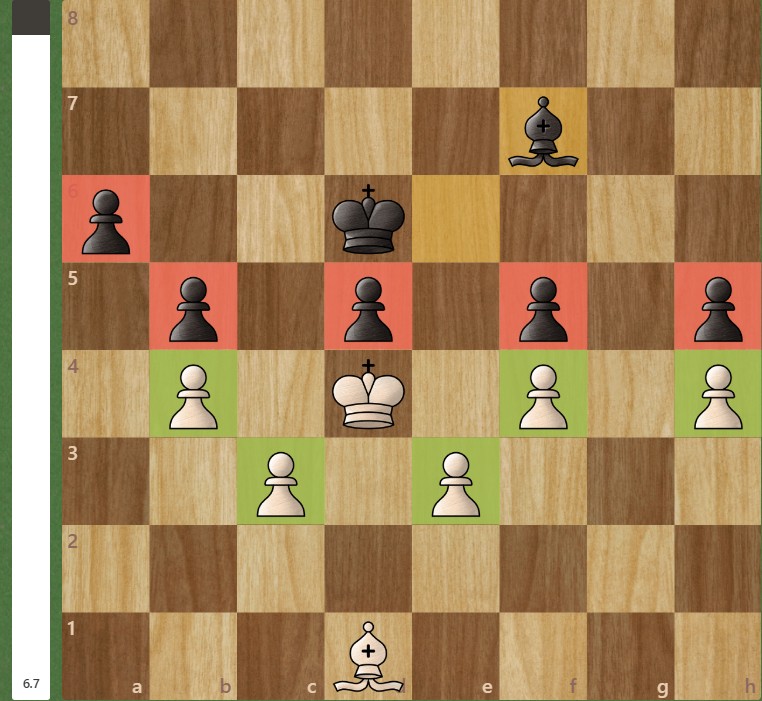
Answer: Bf3. White double attacks pawns on both d5 and h5. Black is now in Zugzwang—he is forced to make an unfavorable move. The two unenviable choices are either to a) move the bishop and lose a pawn or b) move the king and allow White’s king to enter the 5th rank where it will hunt down his pawns. Averbakh wins simply by following Capablanca’s Rule!
Bishop vs. Knight Endgames
“The bishop is a long-range piece, and its strength increases with the openness of the position.” - Alexander Alekhine
We’ve already discussed how knights thrive in closed positions and bishops excel in open ones. It’s no surprise, then, that bishops are significantly more powerful than knights in endgames. In the game below, Bobby Fischer purposely traded off all other pieces to leave the board in a bishop vs. knight endgame.
Bobby Fischer Bishop vs Knight Masterclass
We join this game at move 61. Since move 46, Fischer has been using his bishop to threaten g6 and effectively immobilize Black’s defending knight. Meanwhile, he’s been edging his king toward Black’s other backward pawn on b6. At this point, he’s attacking both backward pawns, and Black is in zugzwang.
On the next move, Black plays 61...Kd8, the best move possible, but still White can win the game. Can you guess what Fischer did next?

Answer: 62. Bxg6! Fischer forces Black’s knight to the side of the board, where its lack of long-range mobility becomes a fatal shortfall. Now White can capture Black’s kingside pawns and attain two connected passed pawns. There’s simply no way for Black to stop them winning promotion!
The *NEW* Austrian Coffeehouse Series Chess Pieces - 4.0" King

DGT 3000 Digital Chess Clock

The Camaratta Signature Championship Chess Table - Dark Brown
Fianchetto Your Bishops Like a Master
“The power of the bishop is fully revealed when it operates along the long diagonal.” - Mikhail Botvinnik
In the early 1900s, the birth of hypermodern chess openings revolutionized chess opening theory. Fianchettoing one or both bishops allows players to control the center from afar. Fianchettoing was certainly not a new idea, but it suddenly became a whole lot more popular.
Most chess players understand the principles of a fianchettoed bishop. By developing a bishop to b2, g2, b7, or g7, it can help control the center as well as the longest diagonal of the board. From here, it is well defended yet exerts constant pressure and can serve both powerful attacking and defensive roles.
It’s here that the long-range capabilities of the bishop really shine. While tucked away on the 2nd rank, a fianchettoed bishop stands ever ready to strike the far corner of the board. This constant threat is easily overlooked, especially in blitz and bullet chess when there is less time to scan for danger.
Nakamura's Blitz Bishop Fianchetto Battery
In this thrilling blitz game between GM Hans Niemann and GM Hikaru Nakamura, both players fianchettoed their light-squared bishops. Despite it being a common defensive strategy, Nakamura demonstrates how fianchettoing a bishop with a castled king can also be a liability. He sets up a queen-bishop battery to x-ray Niemann’s bishop on g2.

With his next move, 17...Ne5, Nakamura forces his opponent to capture the knight and allow him to capture the all-important guarding bishop. Ten moves later, the same bishop rotates around to the same diagonal for another attack on White’s king before being sacrificed to win the game.
This exemplifies Nakamura's spectacular vision and his brilliant use of the bishop. In fact, this has been called one of the greatest blitz games of all time!
Bishop Mating Nets
“The coordinated action of pieces is the foundation of every attack.” - Mikhail Botvinnik
Another superb attribute of the bishop is its ability to combine with other pieces to create a mating net. In other words, a bishop in chess can be used to prevent the escape of the enemy king in a mating attack.
Typically, this involves a bishop placed on either h6 or f6 for White (h3 or f3 for Black) to exploit the 'hole' in the pawn structure in front of the king. Here, the bishop prevents the defending pawn from advancing, while also restricting the king.
While beginners can remember this to create simple mating attacks, advanced chess players frequently combine this chess strategy with a sacrifice to score a more sophisticated, concealed mating attack.

The Library Imperial Collector Series Luxury Chess Pieces - 3.0" King

Luxe Premium Chess Box - Amboyna Burl

The House of Staunton DELUXE Tournament Bag
Mikhail Botvinnik Brilliant Bishop Mating Net
In this game between Grigory Abramovich and former world champion Mikhail Botvinnik, Botvinnik has cleverly placed his bishop on f3, preparing a mating net. Now, it’s Black to play and checkmate White in three moves. Can you see how?
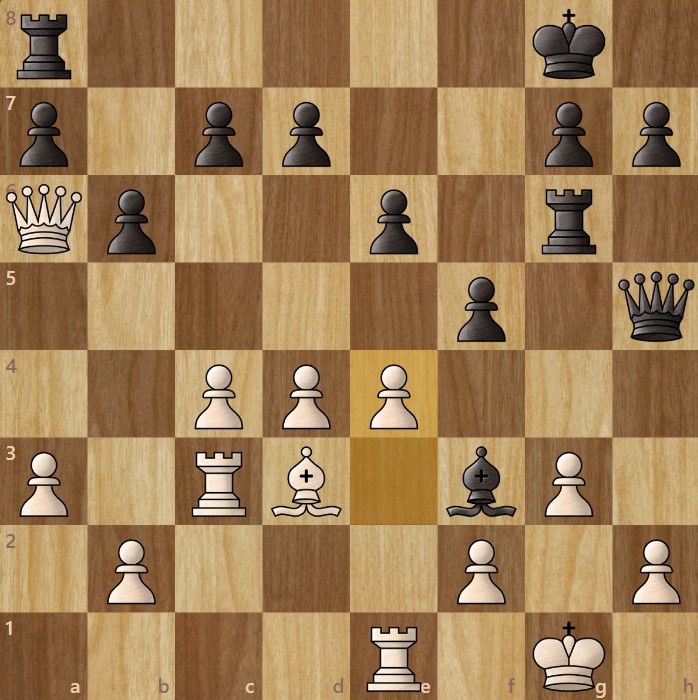
Answer: 17...Qxh2+!! By sacrificing his queen to capture the pawn on h2, Botvinnik cracks open the h-file for his rook to make checkmate on h1. (18. Kxh2 Rh6⁺ 19. Kg1 Rh1#) It's all possible because of the bishop standing invulnerably on f3.
The Bishop in Chess - Key Takeaways from Grandmasters
Bishops often prove to be linchpins of chess strategy, and detonator of chess tactics. Whether you're in a bishop-knight endgame or attempting a bishop mating net, knowing how to use your bishops properly can easily be the difference between winning and losing a chess game.
By studying the way that grandmasters use their bishops and emulating them, you too can wield this often underestimated minor piece with the skill and precision that made the likes of Fischer and Capablanca chess legends.