
Why Is the Immortal Game So Famous?
Throughout the history of chess, a small number of games have become legendary. They may be triumphant victories, heartbreaking upsets, or championship games with dramatic results, such as Bobby Fischer’s defeat of Boris Spassky in 1971. Nestled in amongst these high-stakes dramas, there are games played purely for the love of chess. One such game is the Immortal Game, played in 1851 by Adolf Anderssen and Lionel Kieseritzky. This brilliant example of Romantic-era chess is worth knowing. It might just inspire you to take a risk in your next match!
The Setting
The Immortal Game was played during the 1851 London International tournament organized by Howard Staunton, but it was not a tournament game. This famous game was the historical equivalent of a skittles game, played casually between rounds.
The Romantic era was coming to an end after a period of development from the late 18th century to the middle of the 19th century. This period of artistic and intellectual achievement favored the bold, prizing daring action and intellectual exploration. Chess was exciting and often rowdy, played in coffee houses as well as drawing rooms. The game's expansion was creating both a new type of player and an audience.

The W.T. Pinney Series Chess Pieces - The Camaratta Collection - 4.75" King

Leap Digital Classic Chess Clock
The Players
The two men sitting across from one another at this casual game were anything but casual chess players.
Anderssen
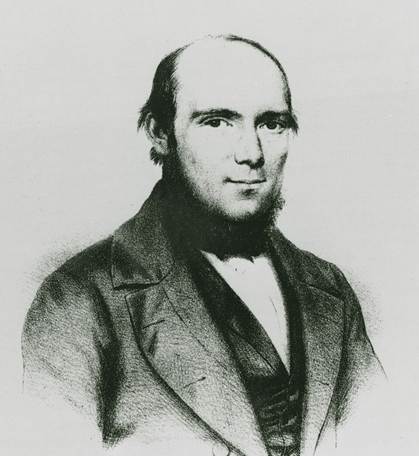
Illustration from the public domain via Wikimedia.
Adolf Anderssen was a German chess master, born in Breslau, Kingdom of Prussia, in 1818. After attending school and college, he taught mathematics in Breslau. His stable income as a professor allowed him to support himself, his widowed mother, and his unmarried sister. Always mindful of his responsibilities, Anderssen pursued chess as a part-time, secondary career. He cemented his place among the elite 19th-century chess masters in 1851, when he won the London International organized by Howard Staunton, followed by a win in the international tournament held by the London Chess Club one month later. Anderssen’s chess career really peaked around 1868, when he turned 50. Chessmetrics puts his highest rating around 2744 in 1870 and ranks him at #1 in the world for a total of seven months around that time. Anderssen died in 1879 in Breslau, now part of Poland.
Kieseritzky
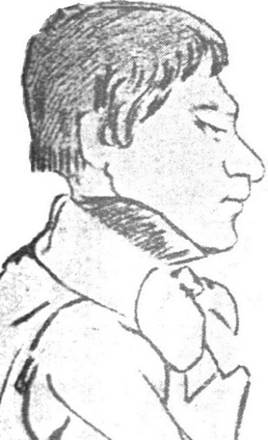
Lionel Kieseritzky was one of the top French chess masters in the mid-19th century, alongside high-level masters like Saint-Amant and Bourdonnais. Born in Livonia, Russian Empire, in 1806, he first worked as a mathematics teacher before moving to France in 1839 to teach and play chess full-time. His historic rankings per Chessmetrics put him at number one in the world for 23 different months from 1849 to 1851, in the company of top players like Anderssen and Staunton, with a top rating of 2734 in 1851. He was not able to parlay his skill into much tournament success, however, losing his first game of the 1851 London International to Anderssen and earning a disappointing tournament total of ½-2½. Kieseritzky died in 1853.

The Burnt Golden Rosewood Grandmaster Series Chess Set, Box, & Gloss Board Combination

Premium Chess Box - Bird's Eye Maple

Millennium Supreme Tournament 55 Electronic Chess Board
Romantic Era Chess
Classical chess in the Romantic Era looked quite different from today. Players used a bolder and less cautious style. They favored daring gambits that their opponent was obligated to answer. This swashbuckling era of chess relied on theory and study, of course, but there was an element of risk-taking and intuition that has been ground out of modern classical chess by endless analysis and defensive positional play.
As chess has evolved, some of the theory considered best in Romantic chess has fallen out of favor, and fair enough—it wouldn’t win most games today. It’s a delight to go back and study these games, however, and appreciate the spirit of experimentation and play that inspired brilliance on the board.
The Immortal Game
Anderssen had white. Kieseritzky had black. Anderssen began with a standard opening, the King’s Gambit, with material development progressing until move 11. Anderssen has left a bishop hanging, and Kieseritzky takes it.
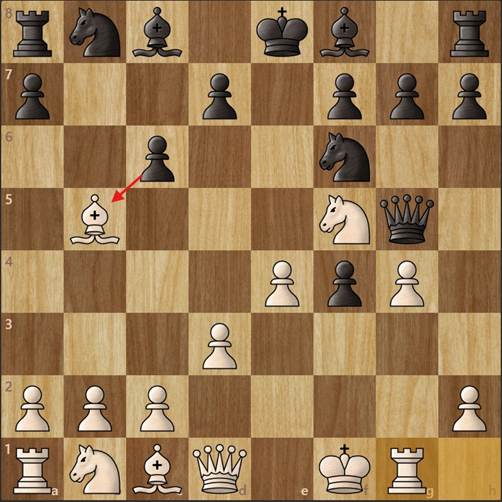
This is the first sacrifice of the game, and possibly the least important, as the bishop was doing little in that position.
The bishop sacrifice is just the beginning of Anderssen’s brilliant attacking strategy. He continues to move his pieces across the board in his signature “heroic attacking style,” while his back rank seems almost forgotten, and is indeed plundered by Kieseritzky. After move 19, white has lost both rooks and sits in an easily escaped check. Anderssen has only taken two pawns.
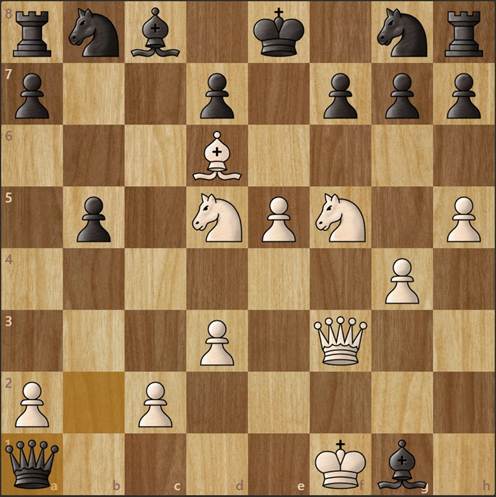
Anderssen is down 13 points of material at this stage! On paper, this is a disaster, but he is not playing for material. From the position above, he moves his king out of danger and then delivers his three-move coup de grace: Nxg7+ for a pawn, and then Qf6+ are the first two forays.
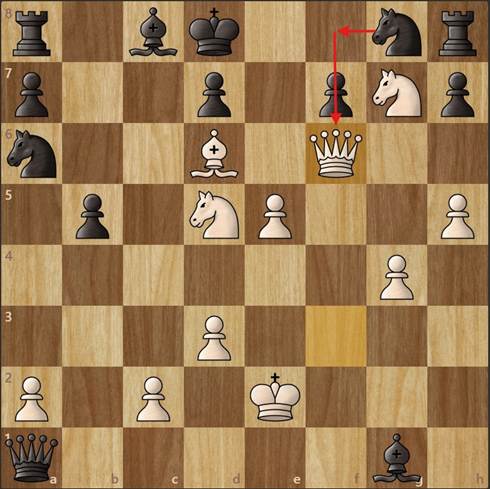
Kieseritzky is forced to take the white queen to escape check. This puts Anderssen down 21 points of material, but it also opens up his winning line with Be7#.
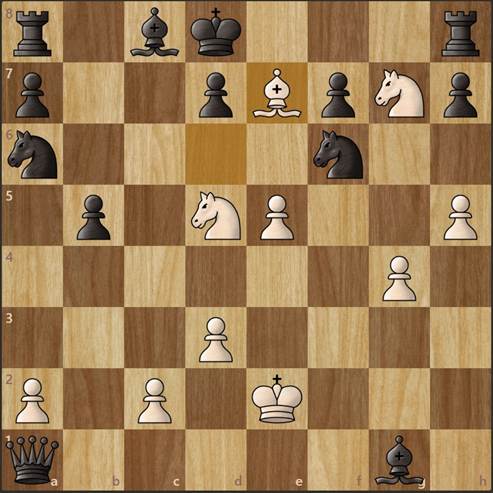
The Immortal Game was relatively short, with 23 moves, ending in checkmate. Anderssen achieved this checkmate with three minor pieces after sacrificing all of his major pieces.
Why Is This Game So Iconic?
Anderssen certainly played many important games of chess, including becoming the world champion in 1851. Why does this casual game get so much recognition?
- Anderssen played a game that violated one of the cardinal rules of chess, preserving your material. He quickly sacrificed his bishop, both his rooks, and his queen, ending the game down 21 points in material. In contrast, Kieseritzky only lost three pawns. These sacrifices came together in an elegant strategic victory.
- This game was all attack on the part of Anderssen, and defensive for Kieseritzky. At no point in the game did Kieseritzky have a viable offensive opportunity. This is a classic example of the brilliant and exciting attacking play of Anderssen. As positional play became the norm, this was less successful. In the
- The Immortal Game is a fantastic example of the exciting and unpredictable play of the mid-19th century. The Romantic era valued unconventional and inspired play. Many players relied on intuition as well as study. Players were exploring the full potential of chess strategy, both good and bad, and it made for some legendary results.
- Anderssen was a high-profile player after 1851 because of his win at the London International. In fact, he’d already defeated Kieseritzky during the first round of the knockout tournament. Kieseritzky was so impressed with Anderssen that he wired the moves to his club in France. La Régence, a French chess journal where Kieseritzky was an editor, published an account of the game. This preserved the game and lent it immediate notoriety.

The Collector II Series Luxury Chess Pieces - 4.0" King

The House of Staunton DELUXE Tournament Bag

DOWNLOAD - Komodo Dragon 3.2
What Can Modern Players Learn from the Immortal Game?
Modern chess has been changed by the ready availability of chess engines and endless computer analysis, leaving less room for innovative or intuitive play. Spectators can second-guess a move with a few clicks on the keyboard. In classical chess, especially, every move is under a microscope, and the goal is often to “not lose” rather than win. It can seem like every scenario has been explored, and the effective counters are all known.
In this landscape, what can we take away from one game in 1851? Alongside the technical study of material sacrifice and lines of attack, it would be valuable to remember that chess is a game. Approached your play creatively, even playfully, and even serious chess masters can find joy in trying something just to see how it works out. Fortune can favor the bold!
Frequently Asked Questions:
The Immortal game refers to a casual chess match played between rounds of the London International in 1851, the first world chess championship. Adolf Anderssen and Lionel Kieseritzky had already played in the tournament, with Anderssen prevailing. The Immortal Game became famous because of the daring and aggressive play of Anderssen. Despite giving up a bishop, both rooks, and his queen, he was able to checkmate Kieseritzky in only 23 moves. It’s a beautiful example of Romantic era chess and well worth studying to this day.
If you were to apply today’s technical standards, the Immortal Game would have a few flaws. As an example of Romantic era chess, however, it’s a fantastic game. The Immortal Game had daring moves, pivotal moments, and an exciting ending with a decisive victory. It was truly an exemplar of the bold and intuitive play of the time. Much like a great football play or a legendary hole-in-one on the golf course, the Immortal Game is more than the sum of the players’ tactical decisions.
Adolf Anderssen was a German mathematics professor and chess master active in chess from around 1842 until his death in 1879. He did not burst onto the scene as a young phenom; rather, he gradually built his chess skills in his spare time. He became the world champion in 1851 at the London International. His peak years were about a decade later. Anderssen played greats such as Howard Staunton, Paul Morphy, and Wilhelm Steinitz, with varying degrees of success. He is still renowned for his brilliant, attacking style of play.
Another Anderssen victory to study is the Evergreen Game, played against Jean Dufresne in 1852. The Game of the Century, a match between then-13-year-old Bobby Fischer and Donald Byrne in 1956, is a classic. Finally, Paul Morphy played the Opera Game in 1858 against two opponents, Karl II, Duke of Brunswick and Comte Isouard de Vauvenargues. The game took place in the Paris Opera House as the opera was performed onstage. Morphy’s opponents were allowed to consult on their moves, but Morphy was more than a match for them, quickly developing his pieces for a checkmate finish.