
Deep Blue vs. Kasparov: The Rise of the Machines
Chess engines are well-accepted and readily accessible staple of playing chess now, but in the 1990s, the idea that a computer could play elite level chess was new and untested. Chess seemed to be the perfect testing field for emerging supercomputers and their powerful number-crunching capabilities. Was it possible for a computer to “think” like a grandmaster? IBM sought to prove that it could with Deep Blue, the first computer to beat a world champion.

Early Chess Engines: Limited Thinkers
The first chess computers were less elegant than the chess engines of today. They exploited the one advantage computers have—the ability to run millions of scenarios in seconds. This gave the computer a "brute force" advantage. Machines never tire, unlike grandmasters, and these early examples would simply overwhelm their competitor with calculations.
How could you compete? A creative human opponent could do something unexpected at any time, interrupting the “best” line. Additionally, computers play conservatively, meaning somewhat predictably. Unless the computer was programmed for a specific opponent, as Deep Blue was, play would be conventional and straightforward. Any grandmaster would find that predictability to be to their advantage.

The *NEW* Austrian Coffeehouse Series Chess Pieces - 4.0" King

DGT 3000 Digital Chess Clock

The Camaratta Signature Championship Chess Table - Dark Brown
IBM and Deep Blue
In the late 20th century, computer companies were keen to test the limits of computing with new "supercomputers" using parallel processing. In 1989, IBM hired Feng-hsiung Hsu and Murray Campbell, the computer scientists working on Deep Thought. Renaming the project Deep Blue, they tasked the team with beating the world's best chess player. GM Joel Benjamin was hired to teach the computer how to “think” like a chess player (with the advantage of examining 200 million positions per second).
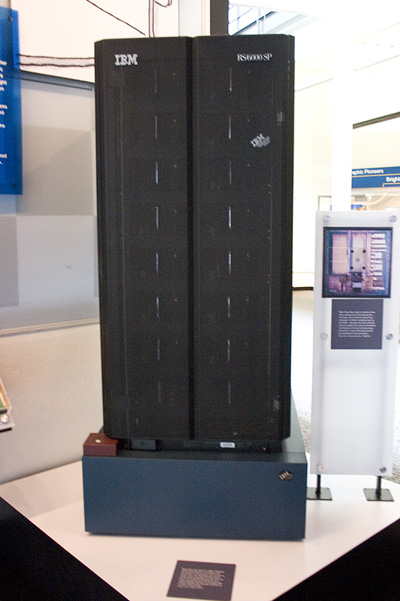
In 1996, GM Garry Kasparov had been world champ for over a decade and was approaching his peak ELO rating of 2851 (1999). Kasparov was skeptical that the computer could beat him, so why not test his skills? He’d beaten Deep Thought twice in 1989. How hard could it be? (Spoiler: It was extremely hard.)
1996: Match One
This wasn’t a rematch with Deep Thought, as the chess computer was a completely different machine. IBM offered a large cash prize--$400,000 to the winner and $100,000 to the loser. This would be around a $1M purse in today’s dollars. Deep Blue decided its moves, but the human team made decisions on draws and resignations.

Match Highlights:
- Game 1-Deep Blue vs. Kasparov: Deep Blue won this game. It was the first defeat of a reigning world champ by a computer in standard classical time controls.
- Game 2-Kasparov vs. Deep Blue: The computer resigned after 73 moves. Deep Blue had a configuration error that prevented it from accessing its opening book, but it cobbled together an opening. Kasparov blocked the computer, and it could not develop its positions.
- Game 3-Deep Blue vs. Kasparov: Kasparov played the Sicilian Defence and Deep Blue pulled out the Alapin Variation. This game was a draw after 39 moves.
- Game 4-Kasparov vs. Deep Blue: This variation of the Queen’s Gambit Declined lasted 50 moves. After the Deep Blue team declined a draw offered by Kasparov earlier, the game ended in a draw anyway.
- Game 5-Deep Blue vs. Kasparov: With the score tied, the match turned here. Kasparov successfully played black to a resignation by the IBM team after the 47th move. Kasparov offered a draw at move 23, which the human members of the Deep Blue team declined.
- Game 6-Kasparov vs. Deep Blue: Kasparov frustrated the computer at every turn. Small, strategic moves advanced Kasparov’s position and closed off Deep Blue’s opportunities. Deep Blue resigned after 43 moves.

The Broadbent Series Chess Pieces - 3.0" King

Fitted Briefcase Chess Box - Mahogany

DOWNLOAD - Chess King Learn Beginners 6 - Forever Pack All Platforms
Kasparov won the match 4-2. His aggression and ability to think on his feet could not be matched by the machine. While Deep Blue could crunch hundreds of millions of variations, it could also be taken out by a programming error. Kasparov walked away with the purse and renewed conviction that computers could not surpass humans.
1997: Rematch with New and Improved Deep Blue
In 1997, Kasparov agreed to a rematch with another large cash prize. IBM used the time between matches to bring in more GMs to “teach” the machine how to play more strategically. Engineers made several improvements, key among which was the ability to disguise the computer’s strategy to throw opponents off.
Match Highlights:
- Game 1-Kasparov vs. Deep Blue: A sub-optimal move by Deep Blue at move 44 decided this game. IBM claimed a bug triggered a fail-safe move when Deep Blue couldn’t select a better one. Kasparov won using the Réti Opening and King’s Indian Attack.
- Game 2-Deep Blue vs. Kasparov: This was the most controversial game in both matches. Kasparov resigned after a string of unusual moves by Deep Blue, including passing on material gains. Kasparov believed it was human interference, a claim IBM rejected. The world champion also missed a potential winning line of play. Kasparov’s error and the unusual play of the machine made for a strange day for everyone.
- Game 3-Kasparov vs. Deep Blue: Kasparov tried to confuse the computer by playing an unusual opening, the Mieses Opening. It didn’t work, and the game was drawn at 48 moves.
- Game 4-Deep Blue vs. Kasparov: Kasparov got into time trouble and played some rushed moves, leading to another draw.
- Game 5-Kasparov vs. Deep Blue: IBM’s focus on endgames paid off, as Deep Blue was able to turn an expected win for Kasparov into a draw.
- Game 6-Deep Blue vs. Kasparov: The score was tied 2½-2½ after five games. Kasparov predicted that Deep Blue would play conservatively for material gains. A shocking knight sacrifice by Deep Blue scuttled Kasparov’s strategy. Finally, Deep Blue won after only 19 moves and claimed the match win at 3½ -2½.

The Harrwitz Series Timeless Chess Pieces- 3.5" King

Super Deluxe Tournament Director Kit

Large Wedge Chess Clock Carrying Bag
Historians are split on what this victory meant. Many point to the uncharacteristically bad play of Kasparov as the main factor in his defeat. Kasparov was dismissive of the machine’s victory, suggesting that more creative moves implied human intervention. While unquestionably a triumph in the advancement of computers, it may have been a case of beating the best in the world on a bad day.
The Outcome vs. the Impact
The immediate impact of the Deep Blue competition was, of course, advertising. IBM gained valuable bragging rights. Computing was touted as the future of decision-making and enterprise growth. Was the machine smarter than the world champion, though? Kasparov’s games and playing style were well known, and Deep Blue's programming was almost bespoke. Kasparov did not have the same access to study his opponent.

Photo by Geoff Brooks on Unsplash
The impact of Deep Blue was undeniable, however. Chess has long been seen as a pinnacle of human intellectual achievement, and here was a machine giving the world champion a run for his money. In the imagination of the public, it certainly advanced the idea that machines were capable of “thought.” Machines like Deep Blue were precursors not just to modern chess engines, but they also paved the way for the development of large-scale predictive algorithms and AI models today.
Modern Machines and Their Oversized(?) Role in Chess
It’s fair to say that chess has evolved into a completely different playing field in the last 30 years. While the game and the humans are substantially the same, the ways players learn and prepare are much more reliant on chess engines.
The biggest impact of chess engines is the ready availability of a challenging game of chess 24/7 around the world. Chess bots and apps have become an integral part of learning and improving at chess. Grandmasters use engines to prepare for games and advance their skills. Engines can even mimic a certain opponent, allowing anyone to “play” Magnus Carlsen or another elite player.

The Fischer Spassky Series Chess Pieces - 6.0" King

DOWNLOAD - CHESSBASE '26 - Premium Package

The Millennium King Competition Chess Computer
It’s been a mixed bag for competitive chess, however. Some people believe that heavy reliance on engines has made chess more predictable and prone to draws. Commentary at matches often relies heavily on engines, giving the impression that very difficult decisions made by gifted players are “obviously” wrong.

One other not-so-great impact of chess engines is an epidemic of cheating and related accusations. Online chess is especially vulnerable as players rely on the honor system. Tournaments have banned electronic devices and implemented scanning to ensure no electronics are hidden in the room. While cheating is nothing new (see the many documented violations of the touch-move rule), fighting the use of chess engines is particularly thorny. Numerous high-profile investigations have resulted in bans for grandmasters in recent years.
Brilliance Still Makes the Difference
Deep Blue was a revolutionary step forward for computing, but what did it do for chess? GM Kasparov did something great for chess when he took on the machine. Computer chess programs became standard for players who wanted to learn and improve. More than that, however, Deep Blue vs. Kasparov showed that while computers could be “better” at chess than people, the human side of the story is what draws us in.