
How to Learn Chess at 50: Am I a Chess Player?
When people find out I write about chess, the inevitable question is whether I play. “I’m not much of a chess player” has been my standard answer. This series of articles chronicles my learning path to get from “not much” to “capable.” I’m almost there! While I’m not claiming amazing technical prowess, I can explain and put into practice the fundamentals of a good chess game, apply proper etiquette and skills in a game, and follow a chess match with keen interest. That’s a lot of progress for a few months! Now it’s nearly time to take it on the road.
Reviewing the premise: My name is Rebecka Ratcliffe. My previous articles, How to Learn Chess at 50: Getting Started, How to Learn Chess at 50: Learning the Basics, and How to Learn Chess at 50: Improving Every Day, will introduce you to my attempt to learn (and relearn) chess from the board up. I hope you enjoy my honest, light-hearted recounting of a chess journey taken a bit later than most.

What I’ve Been Doing to Learn Chess
At this point, I’m primarily playing games and completing puzzles. This might be a little controversial. A more formal approach might have me learning about specific tactics or openings. While my lessons on Chess.com continue to progress to new topics, I’m not diving deeply into any one area.
My reasoning for this is two-fold. I am not training to be a competitive chess player, first of all, I just want to play a competent casual game. Additionally, I enjoy playing a more intuitive game. I don’t want to memorize chess tactics and counters in order to know what’s “expected” in certain positions. Will that make me a weaker player overall? Yup, most likely. I am unbothered by that prospect at this juncture. My pattern recognition is definitely improving as the puzzles are getting harder.
There are a couple of specific things I’ve focused on as I prepare to join a chess meet-up for the first time. Let’s get into it!

The Library Collection - The Anderssen Dropjaw Series Luxury Chess Pieces - 3'' King

Millennium eONE Electronic Chess Board for playing on chess.com
Specifically, Time Controls
One of the best pieces of advice for older beginners (or really any beginner) is to play slow chess. Most people don’t do this in matches, however, unless it’s an extremely casual or correspondence game. It’s time for me to really learn time controls.
Time controls make the length of a game predictable. Each player is allotted the same amount of time to complete all their moves (typically). The length of time for classic chess is longer, usually at least an hour per player. Rapid chess is between 10 and 60 minutes per player. Blitz is anything under 10 minutes. Time controls can also be used to level the playing field, much like a golf handicap, by granting the weaker player additional time. (Discussion of increments and delays is beyond our scope here—I could write another article about all the variations and how they’re used!)

Using Your Phone as a Chess Clock
For a low-cost, convenient solution, there are a few phone apps that are free or relatively inexpensive. I downloaded the free ChessClock app from Chess.com on my iPhone to try it out. As you can see below, it’s a very simple interface where each player touches their side of the screen with a fingertip after moving. It can be set at multiple time intervals with or without Fischer delays. It also has a custom option. This would work fine for most people and situations, and it’s a popular way to avoid lugging around a chess clock.
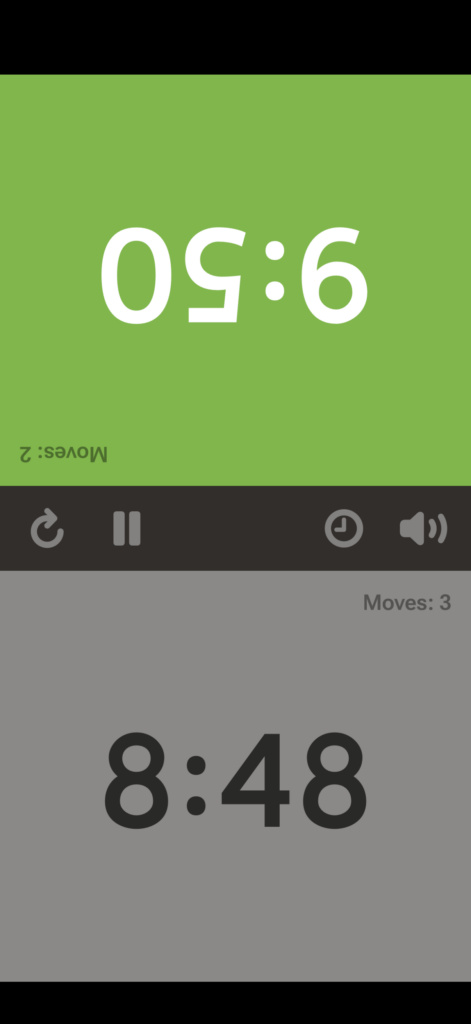
The drawbacks of an app are small but important to think about. One, people will be touching your phone. That may or may not be a dealbreaker. Two, if you don’t tap the phone screen precisely, it might not register your touch, or you might pause the game accidentally. For some rowdy styles of play, that might be problematic. You also need to make sure your phone is charged and notifications are turned off, which can be inconvenient. Note: Most tournaments are not going to allow you to have your phone, for obvious reasons.
Or…Using a Chess Clock

The Fischer Spassky Series Chess Pieces - 6.0" King

DOWNLOAD - CHESSBASE '26 - Premium Package

The Millennium King Competition Chess Computer
The other option for chess timing is a stand-alone chess clock. I ordered the Z-Mart Fun II for myself in a snazzy black and blue colorway. It’s simple enough to set up, but you’ll want to refer to the manual for how to access the menus and adjust the time and increments/delays. The advantages of a stand-alone clock are fool-proof function, more options for time setup, and a highly visible readout. It also keeps your phone free if you need to be available for work or family reasons. The disadvantages are carrying another item (though most will fit in a chess bag), the learning curve of setting it up, and the need to buy and replace batteries.
Oh, and Chess Notation
While online play automatically records your chess notation for you, one of my “older learner” quirks is knowing how to manually do things myself. I find this helps me keep up with what’s going on.
I’ve become familiarized via my reading and puzzling with the system of notation, but I wanted to make sure I’d actually mastered it. I spent a few minutes reviewing Learn to Read & Write Chess by Jeanne Cairns Sinquefield, a free resource on the US Chess Trust website. It includes a handy chart of special moves that was particularly helpful. Once I was ready, I numbered a sheet of paper from 1 to 40 in the left-hand column and White and Black at the top. I kept a running record of each move as it happened.
I chose to do this with a bot opponent so I would have a record to check my work against. Tracking notation by hand during bot play was nerve-wracking. The moves were completed so quickly, I really had to be on top of it. I think I would want a lot more practice before attempting it at a tournament. Did I make mistakes? Yes, a couple. Did I find it distracted me from my game? ABSOLUTELY. Again, I’d want more practice before doing this in public.

The Library Imperial Collector Series Luxury Chess Pieces - 3.0" King

Luxe Premium Chess Box - Amboyna Burl

The House of Staunton DELUXE Tournament Bag
Finding Other Humans to Play Chess Against in Real Life
The search for a venue to play live chess took me down several rabbit holes. Using a search engine brought up an assortment of chess academies, clubs, and other gaming places, including an inexplicable listing for Chuck E. Cheese. The listings were somewhat outdated. After clicking a few links and finding one active chess club, I decided to try other resources.

Next, I pulled up my state chess federation for Virginia and perused the club listings. These were better curated, since they were all chess clubs rather than pizza places. Sorting through the listings, I found two decent prospects within an hour’s drive. To find your state federation, check out the USCF Club Search and Affiliate Directory. An hour is still a pretty hefty drive. Time to get creative.
I checked my local library first and sadly did not find a regular chess club. Libraries and community centers often do have chess, but I wasn’t that lucky. Next, I looked on Meetup (meetup.com) for my area—and hit the jackpot! If you’re looking for a casual meetup to play chess, this is a great resource. I think I’m going to head out to a Chess on Tap event at a local brewpub. The setting is casual, beginners are welcome, and there’s no commitment. Meetup also has a rating system, and this group has high marks. I’ll report back on how it goes.

Image by Vesna Zivcic from Pixabay
Coming Up Next:
Prepare, prepare, prepare! The Chess on Tap team says to bring your own clock, so I’ll be practicing with my clock to remove one way to embarrass myself. I don’t think anyone will insist on notation, but I’ll practice a few more times as it helps with board awareness as well. More puzzles and more practice games, and I’ll be ready to venture into the wide world and play!

The *NEW* Austrian Coffeehouse Series Chess Pieces - 4.0" King

Premium Chess Box - Golden Heart

The Large Ultimate Chess Bag
In the fifth installment of this series, I’ll give you all the tea from my trip to the pub and share some closing thoughts. It’ll be a final rundown of what worked, what didn’t work, and what I would do differently. Join me one last time for the culmination of a few months' work on a hobby for a lifetime—and the answer to the question, “Am I a chess player?”