
Discover The Fascinating Muzio Gambit
In the King’s Gambit, there is a legendary line that is both more aggressive and higher scoring than all the rest—the Muzio Gambit. By sacrificing a knight, White wins a crushing lead in development that frequently gives rise to further brilliant sacrifices in an all-out assault on the enemy king.
Not only is the Muzio Gambit one of the most thrilling of all chess openings, but it’s also one of the most successful at amateur level! We’ll also take a look at how grandmasters play this courageous line with some spectacular wins.
Some even say that the Muzio Gambit is the most aggressive gambit in all of chess. Let's see if it's true!
The Muzio Gambit: A Brief History
In the 18th and early 19th centuries, Romantic-era ideals emphasized bold sacrifices and heroic mating attacks as the pinnacle of ‘chess art.’ It’s no surprise then that the King’s Gambit became the emblem of Romantic-era play!
But for many Romantic-era chess legends like Adolf Anderssen and Paul Morphy, sacrificing one pawn wasn’t brave enough. A wild continuation of the King’s Gambit, where White sacrifices a knight and even a bishop, too, became legendary: the Muzio Gambit.
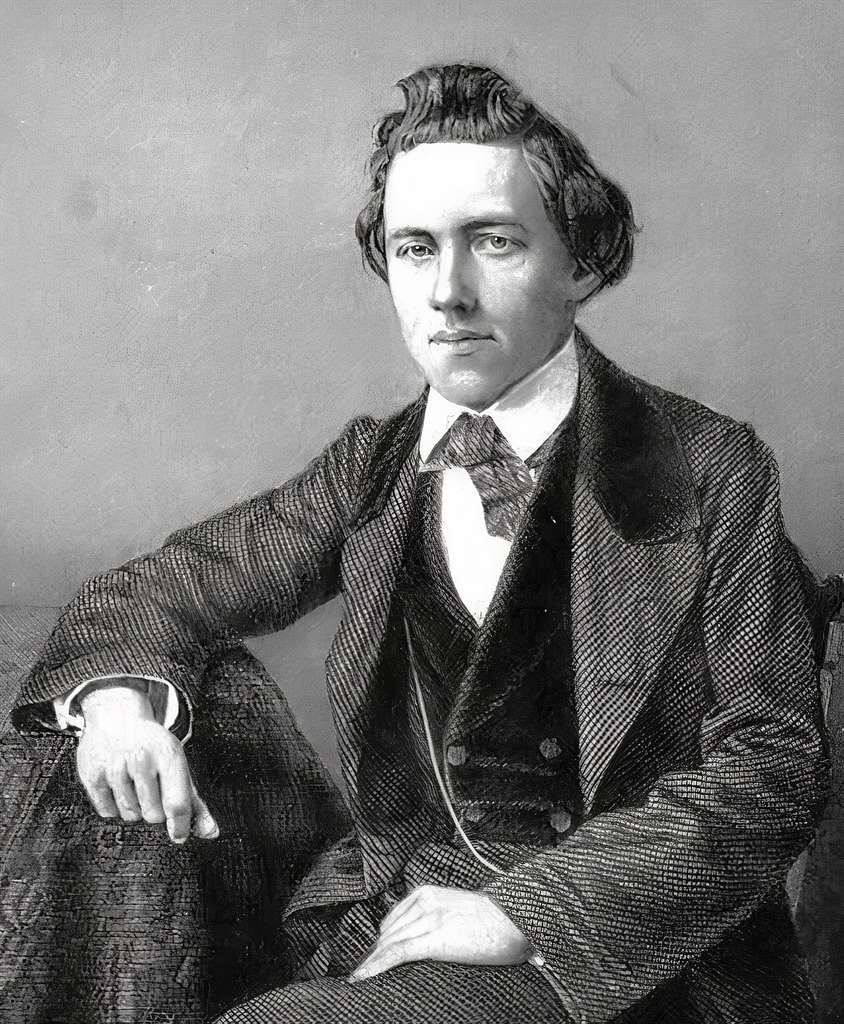
Today, the King’s Gambit is rarely played at the grandmaster level, but when it is, the Muzio Gambit remains surprisingly deadly! Later on, we’ll show you how a 2500-rated player crushed a fellow master in just 15 moves!
At the amateur level, the Muzio Gambit is more lethal than ever. Because it has been largely forgotten about, few opponents know how to counter it properly, and instinctive moves tend to lose quickly! With stunning win rates exceeding 60% in the most commonly played lines, it’s one of the highest-scoring openings in amateur chess!
Arriving at the Muzio Gambit: The King’s Gambit Accepted Main Line
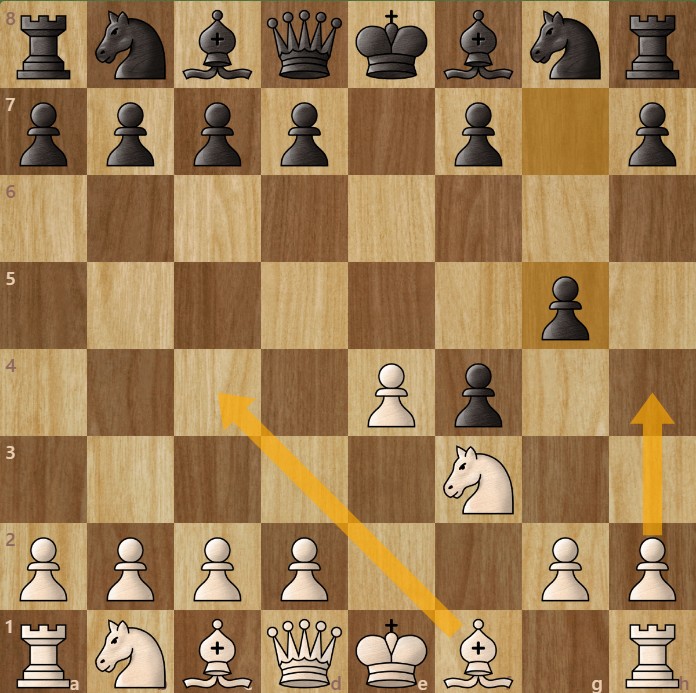
The King’s Gambit is one of the oldest openings in chess. Through centuries of analysis, it became widely accepted that the best line for Black follows: 1. e4 e5 2. f4 exf4 3. Nf3 g5. This main line gives Black a chance to hang onto its pawn advantage while also threatening to kick White’s f3 knight and deliver a menacing ...Qh4+.
White’s standard way to respond to this threat is 4. h4. If Black knows the right moves, however, White may lose its attacking initiative. Instead, White can choose to gambit even more material and gain even more momentum!
Sacrifice a Knight and Gallop Ahead! The Muzio Gambit
In the Muzio Gambit, White begins with a core theme of the King’s Gambit: develop the light-squared bishop to c4 and attack f7. Then after 4...g4, White does something outlandish. Instead of moving the knight to safety, it continues by castling!
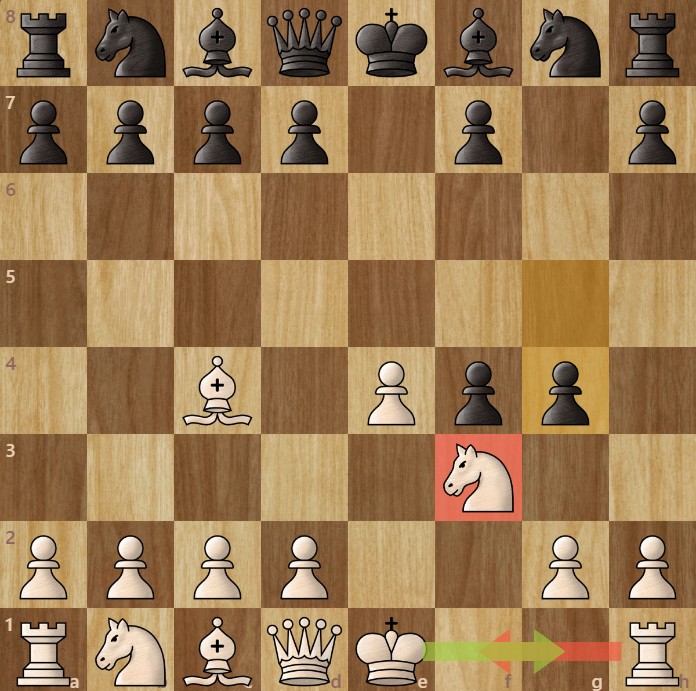
By castling, White moves its king to relative safety while also transferring its rook to the semi-open f-file, where it can join the attack on f7. After 5...gxf3, White has several options: 6. Bxf7, 6. d4, and 6. Nc3 all score well for White, but 6. Qxf3 is the most conventional line and the one we'll study.
With the White queen now adding even more pressure on the f-file, Black will usually attempt to obstruct the mounting attack with 6…Qf6. To shift it out of the way, gambit another pawn with 7. e5. Black usually accepts.
The Double Muzio Gambit: Bxf7
After 7...Qxe5, you have two main options. You can either play 8. d3 to open up your dark-squared bishop to join the attack, or go for the spectacular Double Muzio Gambit: 8. Bxf7. Sometimes known as the 'Wild Muzio Gambit', this line sacrifices the bishop, too!

Let’s look at the statistics among club-level players for these two moves:

Since 8. Bxf7 scores better, we’ll follow that line. After Black recaptures the bishop with its king, you’ll gambit yet more material with 9. d4. Your opponent will likely think you’ve gone mad and happily grab the pawn with a check: 9… Qxd4+. You hit back with 10. Be3. Let’s take a look:
1. e4 e5 2. f4 exf4 3. Nf3 g5 4. Bc4 g4 5. O-O gxf3 6. Qxf3 Qf6 7. e5 Qxe5 8. Bxf7+ Kxf7 9. d4 Qxd4+ 10. Be3
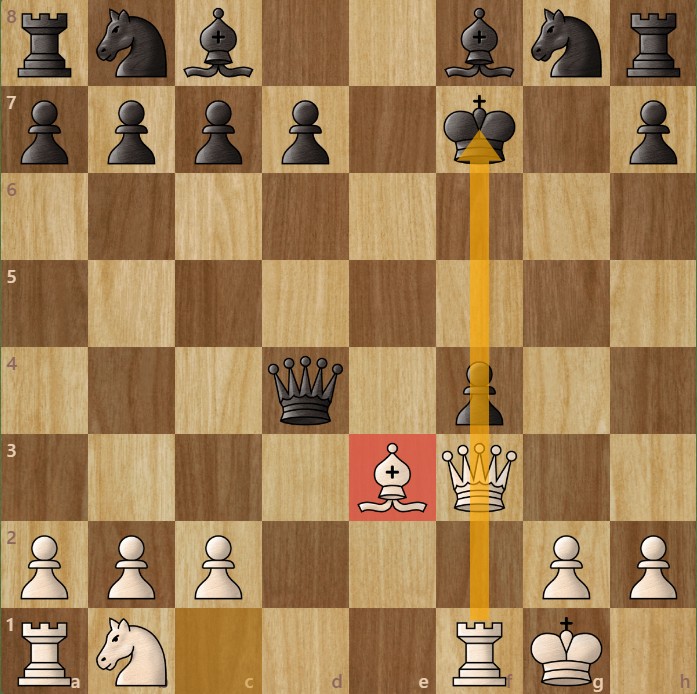
Now, Black is up a colossal 7 points in material, yet straddles an incredibly precarious position! One false move could destroy everything. Even chess engines conclude that Black only has a slight advantage here! In practical play, White wins over 60% of matches.
Since there are a variety of ways that the game can continue from here, let’s see how grandmasters handle this position.
How Grandmasters Play the Double Muzio Gambit
At this point, you might be thinking that nobody in their right mind would play the Double Muzio Gambit. How could White's attack ever compensate for the 7-point material deficit?!
In fact, many grandmasters have played it, and White usually wins! In this game between Alexei Shirov (2500) and Jerzy Łapiński (2200), Shirov played the exact line that we’ve been discussing. Play continued: 10...Qf6 11. Bxf4 Ke8 12. Nc3 Nc6 13. Nd5 Qg6 14. Rae1+ Be7, leaving the board looking like this. Can you spot White’s winning move?

Answer: 15. Bd6! From here, Black has only one way to prevent forced checkmate: ...Nf6, but Lapinski didn’t find it. Instead, Łapiński answered with 15...Kd8, after which 16. Qf8+ Bxf8 17. Bxc7# spelled game over!
How Paul Morphy Played the Muzio Gambit
The Romantic-era chess legend Paul Morphy was renowned for playing the King’s Gambit in flamboyant fashion. There are several records of him playing the Muzio Gambit—frequently leading to the Double Muzio Gambit, too!
In this favorite line of Morphy’s, instead of castling on move 5, White plays 5. d4 and castles on move 6. This side line, which some have dubbed the ‘Gulam-Kassim Gambit,’ opens up the dark-squared bishop and dominates the center from the start. It also lures Black into a deadly chess trap! Let’s take a look.
1. e4 e5 2. f4 exf4 3. Nf3 g5 4. Bc4 g4 5. d4 gxf3 6. O-O
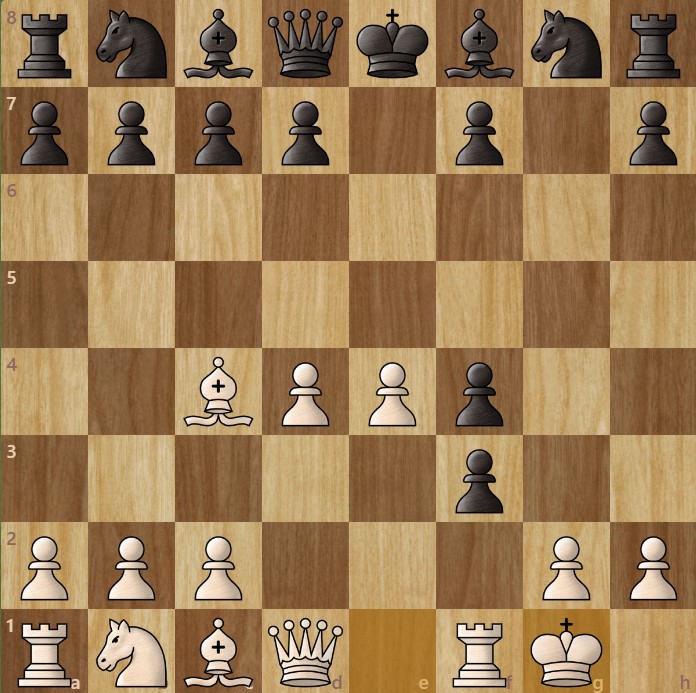
If you had played what most unprepared players play, you would have just lost the game! 6…fxg2 looks like a natural move, yet 7. Bxf7+ Kxf7 8. Qh5+ wins the game! After White’s rook joins the attack, it’s game over for Black.
Morphy vs. NN (Blind Simultaneous Match)
In the following simultaneous match, which Morphy played blind, his opponent didn’t fall into the first chess trap that we’ve just discussed. But Morphy employed other tactics to crush him all the same!
The game continued with 6…d5. 7. Bxd5 c6 8. Bxf7+ Kxf7 9. Qxf3 Nf6 10. c3 Bh6 11. Bxf4 Bxf4 12. Qxf4

At this point, Morphy has eaten up his opponent's kingside pawns, leaving the king almost defenseless. One more slip for Black, and it's all over. That came on the next move: 12…h5. This does nothing to stop Morphy from pushing his e-pawn and removing Black’s sole defender of the king!
The game continued 13. e5 Be6 14. Nd2 Nd7 15. Ne4 Qe7 16. exf6 Nxf6 17. Nxf6 Kf8 18. Nd5+ Qf7 19. Qd6+. By first luring Black’s king out into an exposed position and then piling pressure down the f-file, White overwhelms Black and wins the game.
This is the same theme that you’ll see time and again in the Double Muzio Gambit-type games like this!
How to Win With the Muzio Gambit? It's All About Tactics!
As we can see from these grandmaster games, the Muzio Gambit can lead to a wide range of positions. There’s no prescribed way to win all of them—the way you win is with your tactical prowess!
Emulating the genius of Shirov or Morphy, it’s up to you to capitalize on your opponent’s poor development. With pins, forks, and discovered attacks, it’s all about finishing the job fast before your opponent can develop, defend, and convert their material advantage.
Conclusion
With its fearless sacrifices and relentless attacks, the Muzio Gambit stands as one of the most exhilarating ways to start a chess match. Indeed, it might even be the most aggressive gambit in chess!
Far from being a cheap trick for bullet and blitz chess, the Muzio Gambit is a lethal weapon that scores brilliantly even against advanced opponents at longer time controls. Since it has frequently beaten even the world’s best chess players, it can definitely work for you, too!
Muzio Gambit FAQs
While the King’s Gambit is no longer considered a strong chess opening for grandmasters in classical chess, it remains a superb choice for attacking amateur players looking for a tactical game. The sharpest lines like the Muzio Gambit are still occasionally employed by grandmasters in blitz and bullet games, too!
As chess became more positional, the King’s Gambit mostly fell out of favor among the world’s chess elite in the late 19th century. Emulating grandmasters, amateur players started playing it less too. The truth is, the King’s Gambit remains as effective as ever in amateur chess and deserves to be played far more regularly today!
By sacrificing a pawn with 2. f4, the King’s Gambit aims to give White a head start in development as well as strong central control. Game plans often revolve around using the semi-open f-file to attack Black’s weak f7 square with sharp, tactical play.
Aggressive gambits such as the King’s Gambit are excellent chess openings for beginners. Not only do they make chess much more exciting, but they also help beginners to spot and utilize the tactical opportunities that typically follow. Online statistics also confirm that chess gambits score extremely well at the beginner level.
In 1960, Boris Spassky played the King’s Gambit, Kieseritzky Gambit variation to beat Bobby Fischer. Playing in classic King’s Gambit style, Spassky used aggressive tactics, sacrificing material to open up a fatal attack on Fischer’s kingside. Future world champion Fischer later developed the ‘Fischer Defense’ to ‘refute’ the King’s Gambit.