
Seven Facts About the Staunton Chess Set
Chess sets are often a matter of personal taste. A player might like the way the pieces look, or they may prefer how they feel in the hand. Some sets are highly playable, while others are meant only for display. Where does the desire for the beautiful and the playable intersect? The Staunton chess set design is the answer. Players keep choosing these pieces for a reason. Learn more about what makes Staunton “THE” chess design of the last two centuries.
1. Staunton Chess Sets Are Everywhere
If your family had a cheap plastic chess set any time in the last 50 to 60 years, it was probably based on the Staunton line. Milton Bradley, the famous board game company, introduced a set in 1969 that proudly referenced the Staunton name on the box. While those sets weren’t very good, they were borrowing from a great design.
There are a few good reasons why Staunton chess pieces are so ubiquitous. The design is easy to produce, with simple, turned pieces and few embellishments. Fortunately, this doesn’t detract from their practicality. Staunton pieces are durable and eminently playable. Simple and distinct pieces make it easier to evaluate positions on the board. The main reason for their widespread use, however, is their immediate familiarity to chess players worldwide. So much so, in fact, that FIDE adopted the Staunton design as the standard for international play in 1924.

2. Staunton Design Was a Collaboration
Who designed these wildly popular chess pieces? It’s unclear. While they carry Howard Staunton’s name, Nathaniel Cooke registered the design in 1849. He was a publisher and (likely) a relation by marriage of John Jaques, the manufacturer. Jaques of London made other chess equipment, and John Jaques most likely designed the set and produced prototypes with input from Staunton and Cooke. Staunton eventually found the new design “good enough to put his name on,” and hand-signed and numbered sets were sold from 1849 to 1852. After 1852, the sets included a facsimile of Staunton’s signature. Jaques of London still produces a replica set with the signature certificate. While we don’t have documentation of their business arrangement, it was almost certainly some kind of partnership.

The Library Collection - The Anderssen Dropjaw Series Luxury Chess Pieces - 3'' King

DOWNLOAD - FRITZ 21

Millennium eONE Electronic Chess Board for playing on chess.com
3. Advertising and Celebrity Endorsements Worked in 1849
Despite their suitability for serious play, the Staunton chess pieces were not an immediate hit. Howard Staunton was the self-declared world champion of the time, and a popular chess writer for the Illustrated London News. Nathaniel Cooke was an editor at the paper as well. Staunton not only endorsed the pieces, lending his signature to each box, but also wrote extensively about them in his column. Using his influence as a well-known chess master and respected columnist, Staunton promoted the new design and trashed its competitors. Once the pieces gained acceptance in the London chess community, they quickly became the standard worldwide.

R. & E. Taylor (Firm), Public domain, via Wikimedia Commons
4. The Staunton Chess Set Expanded Access to Chess
Chess was moving out of drawing rooms and into coffee houses in the mid-19th century. The growth of middle- and working-class households with both free time and disposable income, even in modest amounts, meant leisure activities were in demand. The Staunton chess set had two major advantages in this market. First, it was mass-produced and therefore affordable. For the first time, a working-class household could afford their own quality chess equipment. Second, the set was sturdy and stood up to the quick and rowdy play of the public house. As an added bonus, Staunton pieces were immediately and intuitively recognizable worldwide, making international play easier. By designing the pieces for manufacturability and serious play, the collaborators struck the perfect note.

The Burnt Dubrovnik Series Chess Pieces - 3.75" King

DGT 2500 Digital Chess Clock

Premium Chess Box - Brazilian Rosewood
5. Staunton Chess Sets Are Collectible
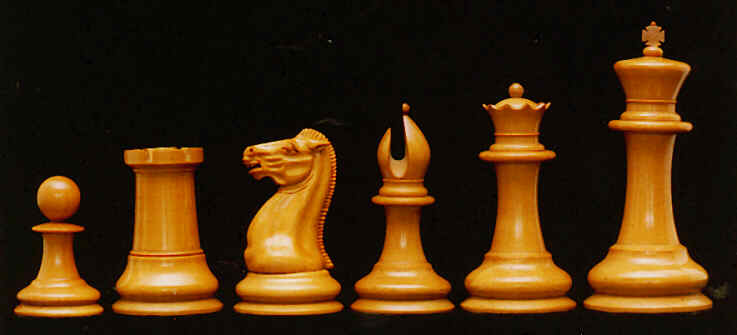
Photo used by permission of Frank A. Camaratta, Jr.; The House of Staunton, Inc.; houseofstaunton.com, Copyrighted; free use, via Wikimedia Commons
Because of their popularity and sturdy design, many Staunton sets have survived for collectors to enjoy today. Prices are relatively affordable, thanks to Jaques of London's mass production. In 2025, auction prices for original sets in decent condition ranged from $350 to $2,000. The Staunton's durability really shows in these sets, as many have only minor wear or a few stand-ins for missing or broken pieces—not bad for 175 years! Many quality reproductions and Staunton-inspired sets are also available on the market today. If you’re a fan of the original Staunton story, but would rather have a pristine set, Jaques of London currently offers an exact replica. It even includes the certificate with Howard Staunton’s signature on the box.

The Harrwitz Series Timeless Chess Pieces- 3.5" King

Super Deluxe Tournament Director Kit

Large Wedge Chess Clock Carrying Bag
6. The Staunton Design is for Players
The Victorian Era (1837-1901) in England had a distinct aesthetic. Decorating and fashion trends were maximalist, with heavy use of ornamentation and decorative flourishes like ruffles and lace. The drawing rooms housing chess sets were decorated to the gills, with decorative objects and finishes on virtually every surface. The chess sets followed suit. Sets like the Barleycorn and St. George were delicate and intricately carved. This made them pleasing to look at and a nightmare to play with, as the pieces toppled or broke easily. The Northern Upright was somewhat simplified, with a flared base, but wasn’t yet the sturdy staple the Staunton design became.
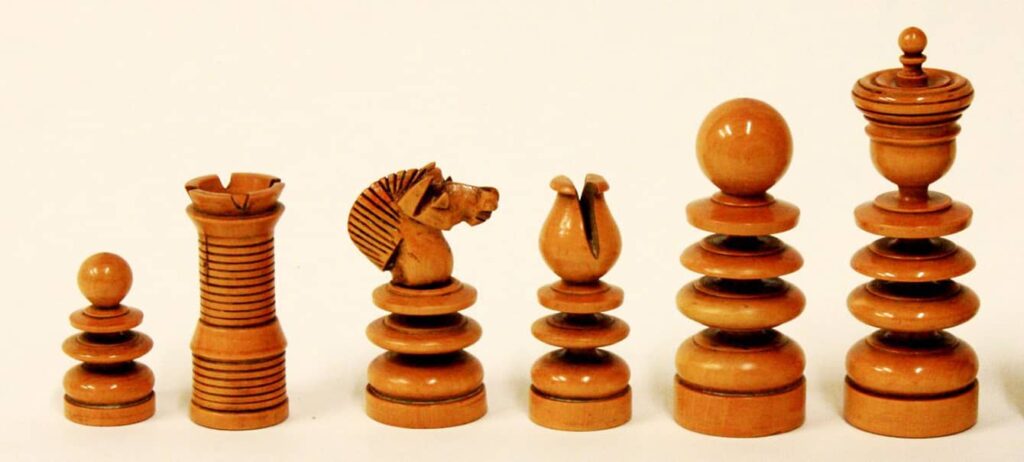
Photo from the Maryhill Museum collection.
The Staunton chess set was the first player-forward design to gain a following. Howard Staunton influenced the design to address his own dissatisfaction with Victorian pieces. He promoted the finished product in the Illustrated London News as “…incomparably superior to any others we have ever seen.” (ILN, September 8, 1849) His endorsement claimed the design was not only aesthetically pleasing but practical for play. This was key to its adoption. The simple, recognizable pieces, durable shapes, and heavier, stable bases made it suitable for any type of play. It was also portable and relatively affordable. Much like the standard tournament set any serious player carries today, the original Staunton was a workhorse.

The Collector Series Luxury Chess Pieces - 4.0" King

The Camaratta Signature Master Chess Table

LIMITED EDITION - DGT 3000 Digital Chess Clock
7. The Staunton Revival Had an Architect
During the last century through the 1980s, chess sets in American homes were generally not very good. You might remember hollow plastic pieces in a cardboard box. In 1986, events conspired to bring the original Staunton design and quality back to the forefront of chess equipment.
Frank Camaratta, who would later become owner of ChessAntiques.com and founder of House of Staunton, went to London to attend a chess world championship. While there, he found an original Staunton set from Jaques of London. Buying and selling these antique sets gave him an idea. “What if we brought back the quality and playability of these sets?” After working directly with Jaques of London for a while, Frank used his engineering know-how to produce high-quality, affordable Staunton pieces that are a joy to play with for any player. His innovations are now the standard for good chess equipment. To learn more about Frank, check out this biographical series.
When It’s Just Right
We don’t know if the Three Bears had a chess set, but Goldilocks would surely have found the Staunton chess set to be “just right.” This timeless design has dominated the chess equipment market since the Victorian Era. If you’ve played competitive chess (or any chess), you’ve probably held Staunton pieces in your hands. With unparalleled playability and simply beautiful lines, the Staunton won’t be knocked off the dais anytime soon.