
What is a Chess Personality
This post was originally written by Sukanya Mukherjee
Did you know your chess personality says more about you than you think? Look, I know that sounds dramatic... but stay with me for a minute. You and I make choices on the board that have nothing to do with theory and everything to do with how we think.
People look at their own games and see patterns that feel uncomfortably honest. You probably do too. That is why this idea matters. In this guide, you and I dig into what creates a chess personality and how it shapes real decisions.
By the end, you will understand yourself a little better.

What Is a Chess Personality?
Your chess personality shows up the moment you start making choices. You repeat certain ideas without thinking, you lean toward positions that feel safe, and you react to pressure in ways that look the same across dozens of games.
Actually, you may not notice these patterns... but they shape your play more than any opening you study.
You reveal your personality through your pace, appetite for risk, and how you handle tense moments. Not just that, but you show it in how quickly you trust your intuition. Also, how long you calculate, and how you respond when the position suddenly changes.
Chess Personality by Chess.com
Nothing about this is abstract. You just express the way your mind works over sixty-four squares.
You can see it in your openings, middlegame plans, and the endgames you either chase or avoid. If you keep choosing sharp positions, that says something.
If you keep steering the game toward calm structure, that says something, too. Your decisions leave a clear trail.

The Camaratta Collection - The First American Chess Congress Series Luxury Commemorative Chess Pieces - 4.4" King

Premium Chess Box - Brazilian Rosewood

Deluxe Chess Board Carrying Bag
Understanding these patterns helps you stop guessing.
You see why some positions feel natural and others feel exhausting. You learn what you’re good at and what you keep sidestepping. And once you recognise that, you can train with intention instead of habit.
That’s all a chess personality is: the patterns you create through play and the patterns you can refine once you finally see them.
Psychological Traits of Chess Players
You start to see a different layer of chess personality once you look past openings and style labels.
Certain psychological patterns keep recurring in how players study, compete, and react when the position turns sharp. These traits won’t magically raise your rating, but they influence how you think through problems and how you hold yourself together when the game stops behaving.
Some of this comes from research. Some of it comes from decades of watching how real players handle tension and training.
Big Five Personality Traits in Chess
Researchers have examined chess players using the Big Five model, but the interesting part isn’t the terminology. It’s what the results say about how players actually behave.
Players often score higher in Openness, which fits what you see over the board. You need curiosity and mental flexibility to explore complicated positions, learn new ideas, and willingly sit inside uncertainty.
Conscientiousness shows up too, especially in players who love routines, structured study sessions, and clean post-game analysis.
Agreeableness tends to dip a little in active tournament players, not because they lack kindness, but because they tolerate conflict and competition better than most people.
Strong players also trend lower in Neuroticism, which tracks with what you and I see every day. If you crumble under pressure, you lose winning positions. If you stay calm, you convert them.
The research shows the same patterns in younger players.
Other Psychological Models: MBTI and MMPI
You’ll also see people use MBTI or older MMPI profiles to describe chess tendencies. None of these models measure strength, but they do capture temperament in a way players recognise.
Many serious players get typed as INTJ, INTP, ISTJ, or ISTP. This lines up with how these players think. They like independence, logic, problem-solving, and long stretches of focused work.
They don’t need noise or constant validation. Also, they enjoy figuring things out on their own terms, which is, at heart, the essence of chess study.
MMPI-based research from decades ago found similar trends.
Tournament players usually sit comfortably inside long stretches of quiet thinking. They handle complicated positions without panicking, and they don’t mind digging into unusual ideas when the position needs it.
These traits make the grind of long, mentally taxing games feel much more natural.
Together, these models show a simple truth: people who enjoy deep thinking tend to find comfort in chess. People who panic under mental load tend not to.
Measuring Chess Personality Scientifically
If you want to understand your chess personality, you can’t rely on vibes, guesses, or the stories you tell yourself after a game.
Modern chess data makes patterns surprisingly measurable.
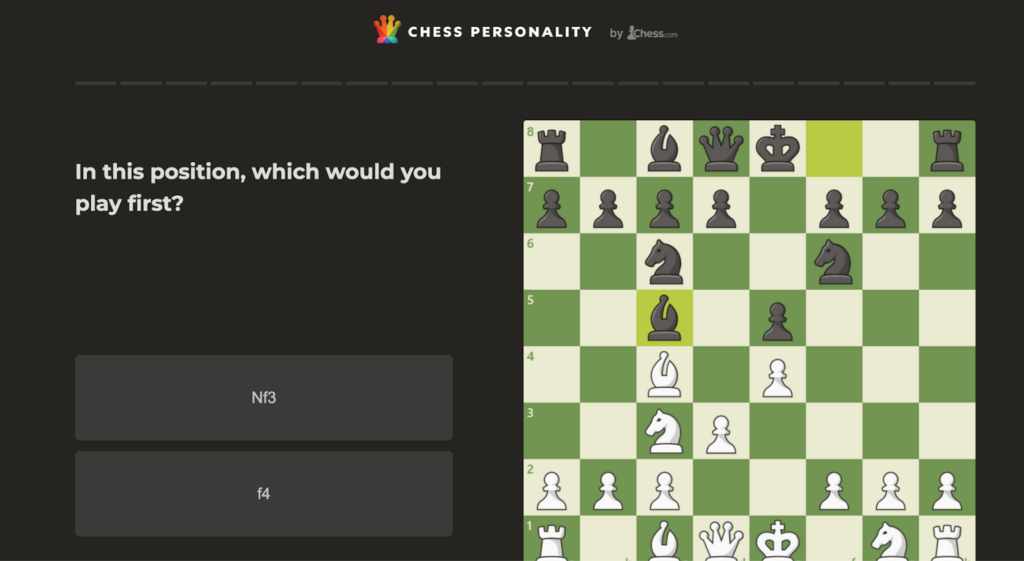
Inside Chess Personality Quiz
Researchers can track how you approach complications, how quickly you commit to plans, how often you avoid exchanges, and even which types of puzzles expose your blind spots.
If you look at elite players, their “data trail” is even louder. Garry Kasparov’s games show relentless initiative; almost every cluster of his moves screams dynamic play.
Magnus Carlsen’s profile looks completely different. He has steady pressure, tiny advantages, and almost machine-like patience.
Engines picked up these contrasts years ago, which is funny, because chess machines have personalities too.
AlphaZero plays like a creative attacker; Stockfish plays like pure calculation. Even computers leave patterns once you track their decisions.
Opening Repertoires and Preferred Systems
What you open with often says more about how you think than you realize. Your favorite openings and the systems you return to most frequently can form a clear signal of your underlying chess personality.
The idea is simple: if you repeatedly gravitate toward certain openings, that reflects what you feel comfortable with.
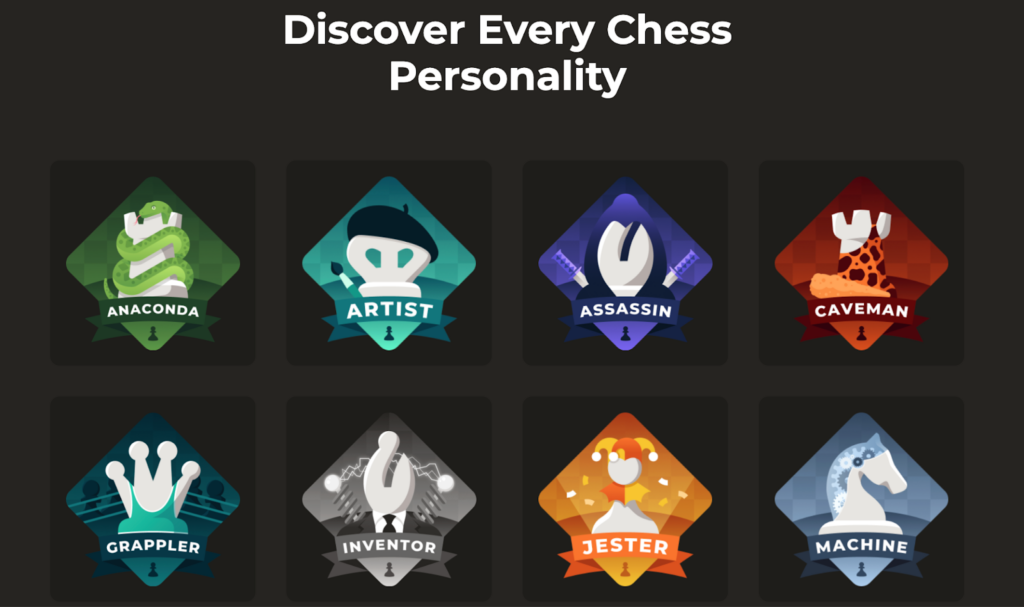
For example, Chess Personality lets players take a quick test and then recommends openings based on their self–declared preferences.
Chess Personality by Chess.com
Many users find the suggestions uncannily accurate. If you choose an aggressive archetype, you might be steered toward gambits. But, if you favour solidity, toward closed openings or small-center structures.
From a scientific angle: a large-scale data-driven study found that as players become more experienced, their opening diversity tends to decrease, while they begin to specialize in a smaller set of openings.
How Chess Personality Affects Your Training and Success
If you look at your long-term progress, one thing becomes obvious fast: you don’t improve the same way every other player improves.
You improve based on how you think, how you handle pressure, the positions you trust, and the choices you repeat without noticing. That is why your chess personality matters.
It influences how you study, what sticks, and where you hit plateaus.
It does not decide your rating, but it shapes the path you take to get there.

The Steiner Series Luxury Chess Pieces - 5.0" King

The Reykjavik II Series Tournament Chess Set and Tiroir Combination
Performance Factors
Certain personality traits show up again and again in players who climb faster. Fighting spirit is one of them.
You don’t have to be aggressive, but you need the kind of mindset that does not fold when the evaluation drops... or when the position becomes uncomfortable.
If your personality leans toward structure or routine, you often learn faster because you can follow a training schedule without burning out. If you are more exploratory, you may improve through variety and experimentation.

Chess Personality Test
The goal is not to force yourself into a type.
Tailoring Your Training to Your Personality
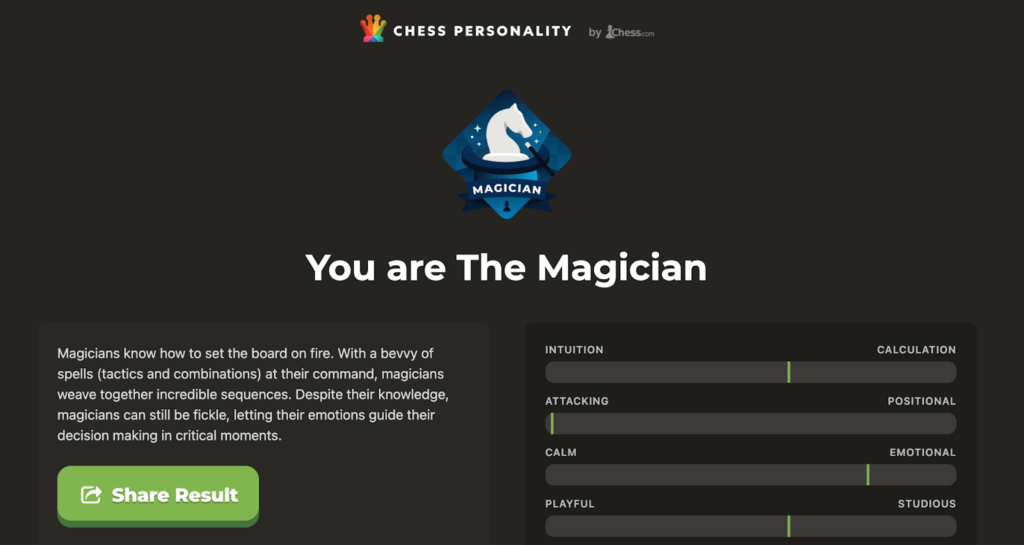
Once you understand your chess personality, you can train in a way that actually fits you. Adding slow, strategic exercises forces your calculation-heavy brain to stretch in a new direction.
Chess Personality by Chess.com
If you lean positional, your challenge is often initiative. Short calculation drills and sharp opening puzzles push you to act when the position demands it.
The point is not to abandon your style. It is to stop training in a way that keeps reinforcing the same habits.
A balanced program respects your strengths but does not let you hide in them. If you thrive with variety, mix your training tools. If you thrive with routine, build a predictable schedule. If pressure throws you off, include more timed exercises. If you struggle to stay focused, break training into smaller blocks.
Your chess personality shows where you are comfortable. Your training should show where you need to grow.
Game Planning and Opening Selection
Openings are one of the easiest places to see your personality in action.
Aggressive players feel at home in openings with early initiative and active piece play. Positional players prefer systems with structure and long-term plans.
Practical players choose openings that reduce risk and cut their opponent’s choices. Experimental players switch systems often and learn through exploration.
There is nothing wrong with choosing openings that suit you. In fact, you should. For most players, success comes from building a repertoire that matches how they naturally think. A sharp player stuck in a dry structure feels trapped.
A patient player forced into chaos often collapses early.
The trick is managing risk. Your personality might push you toward complications or push you away from them, but your results depend on knowing when the position demands the opposite choice.
Good opening planning means building lines you enjoy while still allowing room to grow. You want familiarity, not predictability. You want comfort, not limitation.

The Vigilant Series Luxury Chess Pieces - 4" King

The Scandinavian Defense Revisited: A Cold Blooded Counter to 1. e4! - HARDCOVER
Why Understanding Chess Personality Matters
Understanding your chess personality gives you something players spend years searching for: clarity.
You stop guessing why certain positions drain you. You start seeing patterns you can actually work with. When you know how you think at the board, your training becomes more focused and your preparation becomes more personal.
You no longer copy what stronger players do just because it worked for them. You build a style and a study plan that makes sense for you.
It also makes the game more enjoyable. You recognise the moments that fit your strengths and the ones that challenge you. You learn how to push yourself without ignoring who you are as a player. Most people improve by accident.
You get to improve with intention.
Frequently Asked Questions
They like figuring stuff out, they enjoy solving problems, and they stay surprisingly calm when the position gets messy. They think before reacting, handle pressure better than they admit, and actually enjoy the challenge of long, focused decisions.
Anyone who enjoys thinking for fun fits the game pretty well. People who like patterns, strategy, and a little logical chaos usually get hooked fastest. You don’t need a specific “type.”
It comes down to how you think when the clock is running. Chess players manage stress, calculate while nervous, take risks when needed, and keep their heads clear after mistakes. Their mindset shapes every move, every plan, and every improvement they make