
Chess for Seniors: Benefits and Tips for Older Players
As a sport, game, or mental exercise, chess is excellent for seniors. The main reason? You can keep playing it, and playing it well, at any age. Even if you are only picking up the game later in life, you can become a strong older player and develop a love for the game.

Why Chess is Great for Older Players
Beyond being an enjoyable pastime, chess has a range of benefits, ranging from brain health to social life. Here are a few benefits you can enjoy if you take up chess as a senior.
Cognitive Benefits
Chess has been proven to improve cognitive function across a variety of areas, including memory, planning, and creativity. The rigorous mental exercise of chess is an excellent way to stay sharp as you get older.
Memory
Strong chess players have fantastic memories. Magnus Carlsen can recall specific positions from games he played a decade ago. In a simultaneous blind fold match, he played against 10 amateur opponents at once and won every game. To achieve this, the memory and visualization skills alone are immense.
Memory, while partly innate, can be improved and developed through practice. Research has shown that memorization of openings, combinations, and moves is an excellent way to do this.

Creativity
Chess is a game of pattern recognition, but also creativity. Various studies have shown that regular chess players are better at creative problem-solving.
Often when staring down at a chessboard, we find ourselves at a loss. Even if you understand chess strategy and principles, sometimes the tricky thing is settling on an idea. This is where creativity comes in. Often, there are many options in a position, and even if your plan isn’t perfect, coming up with a new creative idea is often all it takes to get your opponent on the ropes.

The *NEW* Austrian Coffeehouse Series Chess Pieces - 4.0" King

Premium Chess Box - Golden Heart

The Large Ultimate Chess Bag
Planning and Visualizing
Chess is a lot about thinking ahead and visualizing future positions. This is a specific mental skill that translates into other areas of life. Strategy or long-term planning are a key parts of the game. Every move you make should make short-term sense and also contribute to an overarching plan. Chess players become very good at predicting future threats or benefits in a position.
This kind of mental exercise is quite transferable. Overall, the skills chess provides help to keep the brain working well and allow players to become more logical and intelligent thinkers.
Health Benefits
These mental benefits also translate into health. Some studies indicate that chess players are less likely to develop dementia and are better at coping with the symptoms if they do develop it.
Games like chess are generally helpful in battling various forms of cognitive decline. In short, the brainwork involved in chess is excellent for staving off the negative psychological effects some people experience as part of aging.
The social aspect of chess also tends to be beneficial for mental health. As with many hobbies, chess provides a community, a healthy way to pass time, and a daily challenge.
Social Aspects
Wherever you are in the world, you will find chess enthusiasts of all ages. As much as playing chess is learning a skill, it is also joining a community and engaging in an age-old social practice.
As you will see on a visit to most chess clubs and events, the game attracts people of all ages. Chess offers the opportunity to meet people from all walks of life and share in the love of the game.
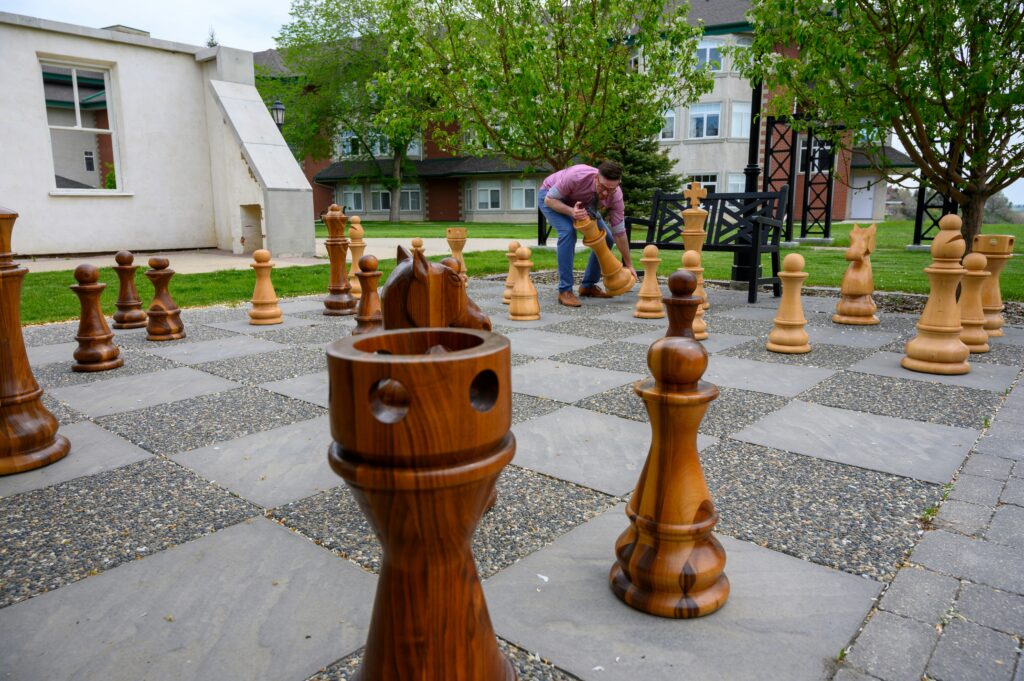
Chess can be played just about anywhere, and park chess has taken on a life of its own in many cities. With chess tables, giant chess sets, or those brought from home, chess enthusiasts can meet in good weather and enjoy playing and spectating.
Tips for Older Chess Players
One of the main reasons people are reluctant to get into chess is that it has a reputation for being a challenging game. While this is certainly true, it is much more accessible than people imagine, and learning the basics doesn't take long.
Here are some tips on getting into the game or becoming a strong older player.

The Fischer Spassky Series Chess Pieces - 6.0" King

DOWNLOAD - CHESSBASE '26 - Premium Package

The Millennium King Competition Chess Computer
Study and Play
Naturally, you can get better at chess by playing the game. However, many beginners play a lot without studying, and this makes it hard to improve.
For beginners, learning one or two openings and some basic chess principles can take you far. There are loads of ways to learn. If you’re serious, you could look into a chess coach or use a friend who’s a good player. Otherwise, there are loads of online chess resources, including blogs like this one, YouTube videos, and courses. If you prefer staying off the computer, there is a vast library of chess books for every level.
My advice would be to start simple: learn a common opening that feels natural. Look at a few variations and try them out in games. Avoid over-memorization or trying to learn too many traps and checkmating patterns. This can make the game less fun and can stop you from learning underlying opening principles.
Play Online and In-Person
Online and over-the-board chess are surprisingly different. Each one has benefits and can teach you various things about the game.
Online chess is incredibly accessible. Platforms like Lichess and Chess.com make it amazingly easy to play a game of chess with any time control at any time. Not only that, but they are full of resources and programs to help you improve. For example, Chess.com has opening lessons, daily puzzles, and an easy-to-use analysis board.
That said, playing over the board in many ways can’t be beaten. The chess set, face-to-face competition, and all-around experience make in-person chess matches a completely engaging experience. A simple chess set is affordable, easy to store, and a quality one can be a great addition to a room. For senior chess players, playing in person may be the preferred choice.
The *NEW* Austrian Coffeehouse Series Chess Pieces - 4.0" King

DGT 3000 Digital Chess Clock

The Camaratta Signature Championship Chess Table - Dark Brown
Analyze Your Games
Chess analysis is simply one of the best ways to get better at chess. This may sound boring, but part of the joy (and pain) of chess is seeing what you missed and how you could have played differently.
Learning how to review your games is an art in itself. However, the basics are pretty simple:
- Go through the game move by move and look for key moments. Where were the blunders or mistakes? And how could you have avoided them?
- Figure out roughly which parts of the game were the opening, middlegame, and endgame. This is helpful because it lets you understand the game's structure and identify areas you need to improve.
- Explore different variations. Having found the most crucial inaccuracies in the game, consider different options. Try to figure out which alternative would be best.
There are plenty of ways to analyze a chess game, both with a physical set and online. However, the easiest is an online analysis board or chess program that lets you review the game you just played, automatically detects good moves and mistakes, and lets you easily explore different variations.

The W.T. Pinney Series Chess Pieces - The Camaratta Collection - 4.75" King

Tap N Set Pro Digital Chess Clock - with DOUBLE DISPLAYS

Signature Fitted Coffer Chess Box - Walnut Burl
Stay Healthy and Sleep Well
As much as chess is good for your health, getting exercise and eating well are also good for your chess. Bobby Fischer and Magnus Carlsen are among the high-profile chess players who have focused on their physical health to improve their chess performance.
Sleep is closely linked to tough mental and physical activity. In many different sports, inadequate sleep is linked to a drastic drop in performance.
While improving health practices is easier said than done, trying to improve at something like chess is a great motivator. Older players who really want to master the game shouldn’t dismiss the importance of exercise, sleep, and diet.
Conclusion: Chess is for Everyone
Chess is great for seniors because it is great for everyone. Aside from being a fascinating and complex game, chess is accessible. All you need is a set and another player, or a device and an internet connection.
As we’ve seen, it can be beneficial in a host of different ways, and with a bit of studying, you can quickly become a strong senior player.